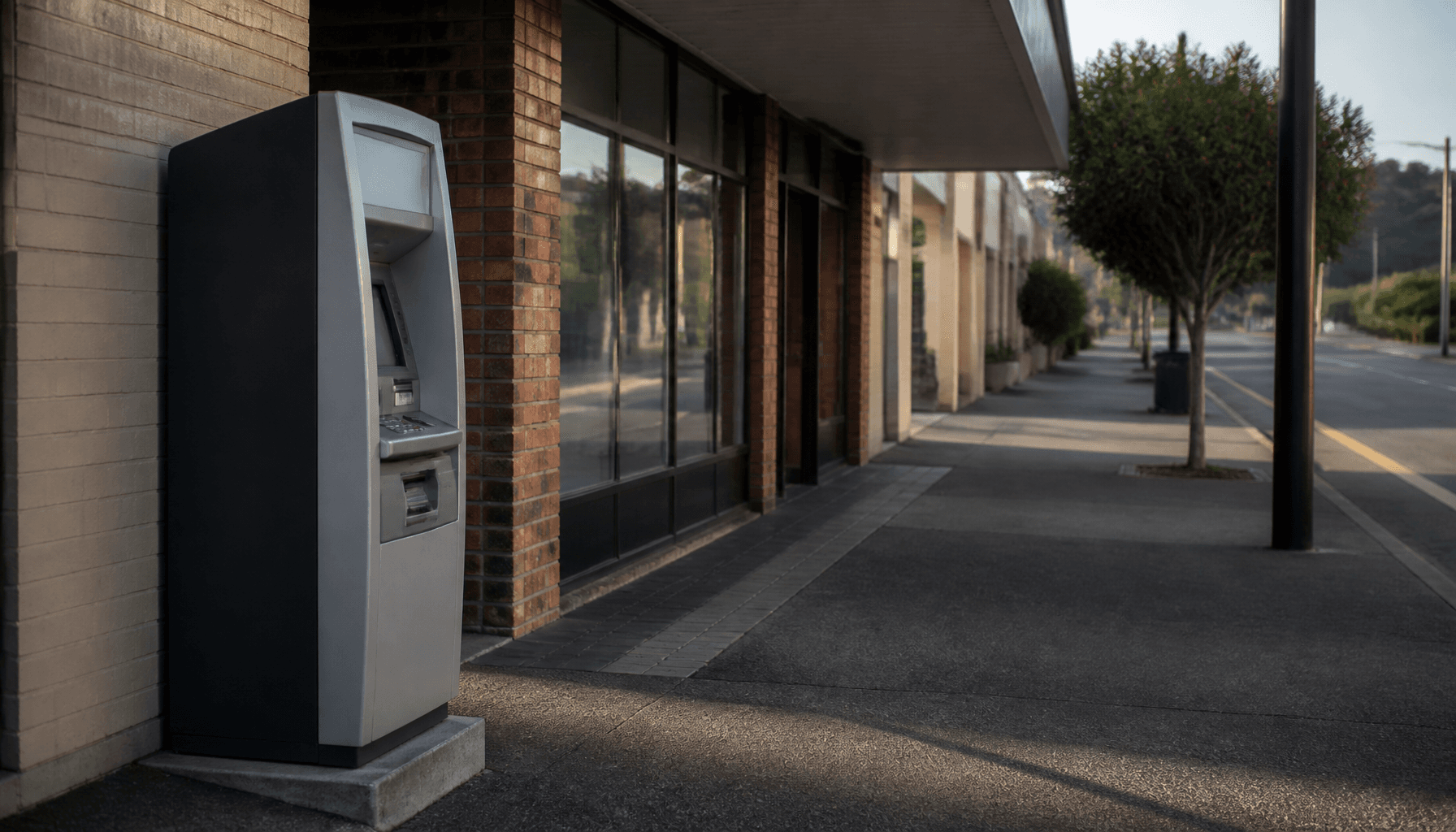
ANZ cut 85 bank-owned ATMs over the past two years. Westpac cut 54 over the same period. In all but 10 of ANZ’s cases, the site contract went to another provider.
Those cuts sit inside a longer retreat. The Reserve Bank of New Zealand says bank branches are down about 40 percent over the past decade. Bank-owned ATMs are down 32 percent over the same span.
Private operators such as Next and Allpoint have filled many vacated sites. Those machines commonly charge about $2.50 to $2.80 per withdrawal. Most banks no longer charge customers for using another bank’s ATM.
The New Zealand Banking Association’s 2024 fact sheet still counted over 1,500 bank-owned ATMs and over 600 branches. RBNZ’s February 2026 Keeping Cash Local paper put the large-bank footprint at about 616 branches and 1,543 ATMs — roughly 2,159 bank-owned cash service sites — plus 1,500 to 1,600 non-bank ATMs.
NZBA chief executive Roger Beaumont has said ATM transactions are only about 1.5 percent of all customer transactions, and that share is still falling. Cash has not vanished. RBNZ’s H3 series showed 40.3 percent of adults used cash for everyday things in September 2025. Only 2.5 percent said they never use cash. Debit card and EFTPOS remained dominant at 80.5 percent.
RBNZ closed its Keeping Cash Local consultation on 31 July 2026 after nearly 6,000 submissions. Findings are due late September 2026. The proposed cash services standard would require free withdrawal, deposit and note-and-coin swap services with geographic coverage rules.
Under the proposal, 95 percent of urban residents would be within about 3 km walking distance of free cash services. Rural settlements of 200 to 999 people would be within 15 km one-way drive. More remote areas would be within 30 km.
RBNZ’s preferred efficient model is multi-bank, full-service cash sites. Only five NZBA regional hubs currently exist — in Martinborough, Ōpōtiki, Twizel, Waimate and Whangamatā — limited to customers of ANZ, ASB, BNZ, Kiwibank, TSB and Westpac.
Geospatial modelling in the consultation paper suggests about 1,293 shared full-service sites could meet the standard. If the large four each built solo full-service networks, the footprint could reach about 5,172 partial sites.