Willis sets hard rules after declining RBNZ’s first $10.1m underspend rollover
Finance Minister Nicola Willis has refused the Reserve Bank’s first bid to roll $10.1 million of 2025/26 underspend into 2026/27 and published three criteria that will govern every future variation under the 2025–30 Five-Year Funding Agreement.
"This decision was made on the basis that the proposed projects include core business that should have been planned for, and it was not clear that the proposed projects could not be funded through reprioritisation."Hon Nicola Willis, Minister of Finance
ASB’s Q2 2026 Regional Economic Scoreboard left Wellington joint last with Gisborne while Canterbury led on dairy cash, jobs and retail. The capital’s multi-quarter underperformance is structural: public-service consolidation, a deep housing correction and stalled population growth colliding with a national OCR still set for nationwide inflation.
Economists expect New Zealand’s June quarter GDP to rise just 0.1–0.2 percent when Stats NZ reports on 17 September, a sharp slowdown from March’s 0.8 percent gain as elevated oil prices compress real incomes.
ASB says nationwide house prices remain about 15% below peak in nominal terms and 30% lower in real terms, with flat 2026 medians and only a late-decade reclaim of late-2021 highs as OCR rises squeeze mortgage serviceability.
Finance Minister Nicola Willis has refused the Reserve Bank’s first bid to roll $10.1 million of 2025/26 underspend into 2026/27 and published three criteria that will govern every future variation under the 2025–30 Five-Year Funding Agreement.
Finance Minister Nicola Willis has declined the Reserve Bank of New Zealand’s first request to transfer up to $10.1 million of 2025/26 underspend into 2026/27. The refusal, set out in a 24 June 2026 letter to Board Chair Rodger Finlay, also locks in three public tests for any future variation under the 2025–30 Five-Year Funding Agreement.
The decision is the first operational stress-test of the hard annual-limit and no-rollover design written into the new funding deal. It converts a transitional cash residue from Project Denby into a standing rulebook. That rulebook trades a modest one-year acceleration of core projects—including Minister-endorsed payments modernisation—for tighter whole-of-Crown fiscal discipline.
Treasury released its assessment (T2026/1033, 11 June 2026) and the Minister’s letter on 10 September 2026. The Reserve Bank updated its funding-agreement page the same day. It confirmed the May 2026 request was declined and that it will prioritise work inside the existing 2026/27 allocation.
Why the criteria matter now
Section 209(4) of the Reserve Bank of New Zealand Act 2021 lets the Minister and the Bank vary a funding agreement by agreement. Clause 7 of the signed 2025–30 FYFA is explicit. An underspend may not be applied to a later year unless the parties agree a variation.
The 2025–30 agreement is the first to operationalise that hard annual-limit rule. The earlier 2020–25 deal had no equivalent prohibition. A 2023 variation increased, rather than reallocated, expenditure. Treasury therefore treated the request as a precedent-setting first case.
Willis’s letter states the decision basis plainly. The proposed projects include core business that should have been planned for. It was not clear they could not be funded through reprioritisation within the FYFA. She expects priority projects to proceed from existing funding.
She then set three future criteria. First, evidence that factors outside the Bank’s control delayed a discrete project planned for the preceding year, where costs cannot be met in the receiving-year baseline. Second, an explanation of why subsequent-year funding is insufficient. Third, identification of risks to value for money and service delivery.
Those tests track Cabinet Office Circular CO (18) 2 expense and capital transfer rules that apply across the public sector. Underspends are residual funding after delivery, not a free contingency. Approving the first request without external-delay evidence would have softened the hard-cap design.
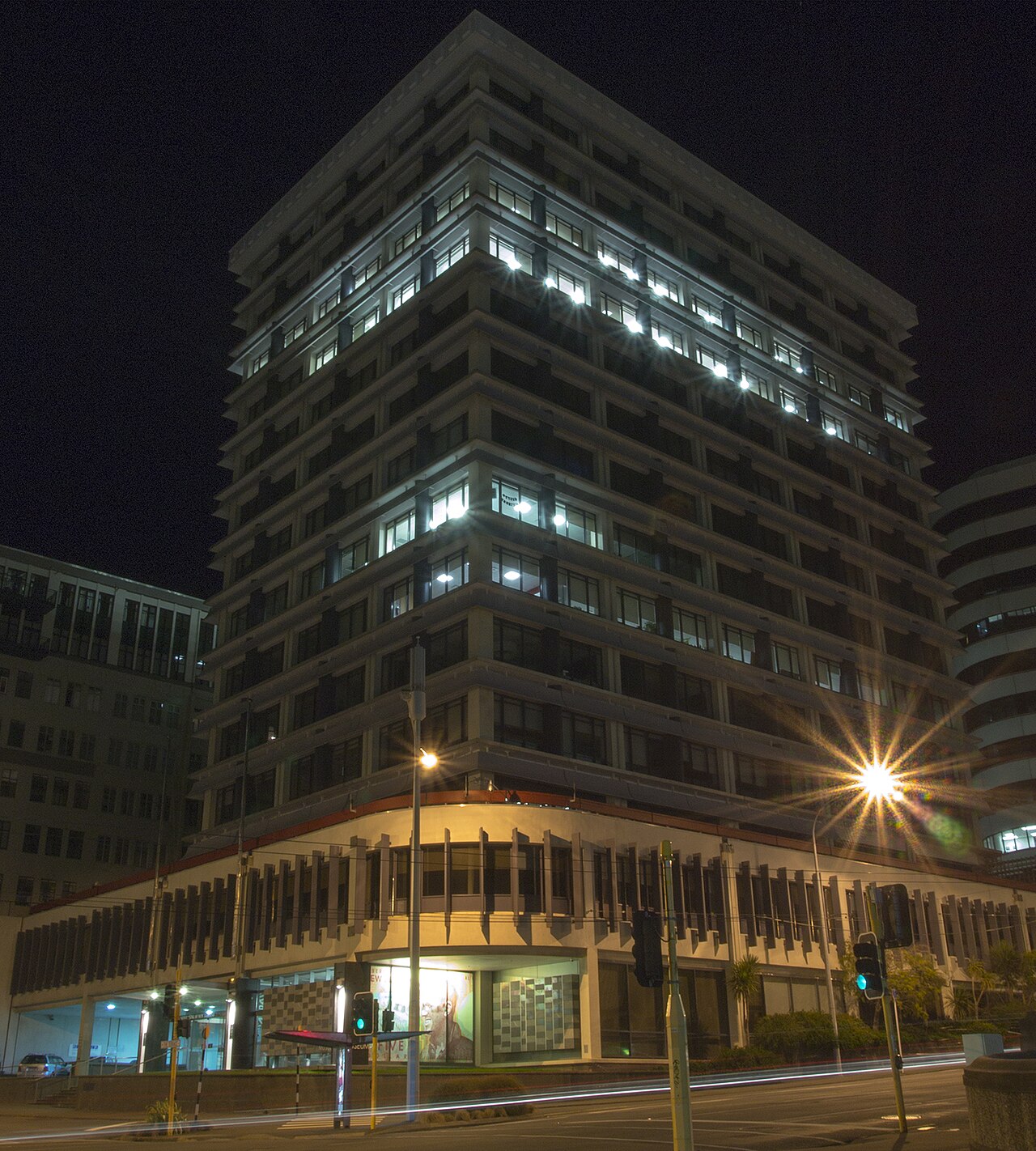
The Reserve Bank's Wellington headquarters, where the Bank must now sequence its work programme inside a hard $145 million annual funding ceiling.
The drivers behind the refusal
The five ranked projects totalled $10.1 million. Payments Modernisation sat first: a project team of about four FTE, consultancy, consultations and a strategic business case. Enable Critical Data Ingestion / Stats Uplift for the Financial Sector Information System ranked second. Economics and Financial Markets capability investment—core forecasting model roles and an analytics upgrade—came next. IT general controls enhancement, via Microsoft and Workday identity and access licences, closed the list.
Treasury said it had no concerns with the substance of any project. It accepted that payments modernisation is strategically important for New Zealand. It still recommended refusal. The projects were core business that should have been planned inside the multi-year envelope. The Bank had not shown external delay factors or clear reprioritisation trade-offs.
The underspend itself was a product of the efficiency programme the Minister demanded. Project Denby cut positions from 751 on 31 March 2025 to 597 on 13 October 2025. Headcount fell from 688 to 554. Expected annual savings were about $11 million. FTEs had previously risen from 255 in 2017/18 to 660 by 31 January 2025.
Treasury’s report linked the forecast 2025/26 underspend to lagging project spend after the restructure, roughly 45 FTE vacancies, unused contingency, one-off provisions such as unused redundancies and the Queen Street lease exit, and business-as-usual underspends. Exact dollar lines remain redacted under commercial confidentiality.
The fiscal backdrop is a multi-year consolidation. Budget 2026’s Fiscal Strategy Report restates short-term intentions to return OBEGALx to surplus by 2028/29, place net core Crown debt on a downward path toward 40 percent of GDP, and drive core Crown expenses toward 30 percent of GDP. Operating allowances have been held tight. Against that path, even a fiscally neutral $10.1 million carry-forward that would otherwise return via the RBNZ dividend was salient.
Annual limits and the envelope
Under the 2025–30 FYFA, total expenditure is capped at $775.6 million: $750 million operating and $25.6 million capital. Annual operating limits are $155 million (2025/26), $145 million (2026/27), $145 million (2027/28), $150 million (2028/29) and $155 million (2029/30). The average annual opex limit of $150 million is 25 percent lower than the Bank’s 2024/25 operating expenses budget of $200 million.
RBNZ FYFA annual operating expenditure limits
Hard yearly caps replace flexible multi-year profiling under the prior agreement.
Source: RBNZ 2025–2030 Funding Agreement
Excluded categories sit outside the hard cap. Currency-related spend is capped at $65 million over five years. Deposit Takers Act project delivery has a separate $15 million allowance to 2027/28. Other exclusions cover litigation, property management of 2 The Terrace, ESAS/NZClear, superannuation and specified major capital business cases.
Final SPE 2026/27 figures, signed 22 June 2026 by Finlay and Governor Anna Breman, show large income-side capacity. Net investment income is forecast at $521 million. Total operating expenses are $219 million, of which $145 million sits inside the FYFA opex limit and $74 million is excluded. Operating surplus is forecast at $333 million. Staff expenses in the final SPE are $120 million—materially above the $101 million draft figure assessed in Treasury’s June report.
The trade-offs
Fiscal discipline versus operational sequencing is the core tension. Refusal returns residual cash to the Crown and protects the hard-cap incentive. Approval would have let the Bank smooth lumpy post-restructure project spend without raising the five-year envelope.
Independence optics versus accountability is the second tension. Willis and Treasury framed the decision as application of general public-sector transfer principles, not a view on monetary or prudential policy. The published criteria are designed to depoliticise future cases. The decision still inserts the Minister into intra-year project ordering.
The decision is the first operational stress-test of the hard annual-limit and no-rollover design written into the new funding deal.
Payments modernisation upside versus $10.1 million of annual purchasing power is the third. The Bank’s August 2026 Issues Paper estimated a potential annual economic boost of $700 million to $1.3 billion, or roughly 0.16 to 0.30 percent of GDP. Retail payments handle around $2 trillion of flows a year. New Zealand remains one of few developed countries without a real-time retail payment system. The economic prize dwarfs the variation. Leadership and platform work must now compete inside the $145 million FYFA opex limit and excluded categories.
New Zealand's retail payments infrastructure is the highest-stakes item now competing for funding inside the Reserve Bank's $145 million annual ceiling.
Multi-year certainty versus annual rigidity is the fourth. The FYFA was designed to enable exactly these projects to be sequenced across five years. Using underspend as a de facto contingency softens that design and risks repeat requests.
The efficiency-programme paradox is the fifth. Denby delivered the savings that justified the FYFA cut and simultaneously created the underspend. Allowing recycle could be read as paying twice for the same adjustment. Refusal may slow the capability rebuild the cut assumed.
Second-order effects for New Zealand
Near-term, the Bank must absorb, stage or drop lower-ranked items inside the $145 million ceiling. Payments Modernisation is first-ranked and Minister-endorsed, so least likely to be abandoned. IT general controls and data ingestion are more exposed to delay. Treasury flagged that recruitment and project-spend lags could persist into 2026/27 for specialist roles even if funding were approved.
Any residual 2025/26 underspend flows back through the dividend calculation once equity sits above the Target Capital Level. That modestly supports the Crown’s OBEGALx path. The transfer would have been fiscally neutral on key indicators if approved. Declining it returns funds to the centre.
Signalling matters for regulated entities. Markets and banks read enforcement of the post-Orr settlement as persistent funding tightness. The 2026/27 Letter of Expectations already pressed continued cost-efficiency evaluation and savings, including Auckland premises subletting. Secondary reporting has put the Takutai Square annual lease near $4.2 million.
Over twelve months, banks, payment service providers, fintechs, Paymark/Verifone infrastructure players and open-banking implementers face an RBNZ that must sequence reform leadership inside a hard budget. Consultation on the payments Issues Paper ran from 18 August to 27 October 2026. Advice to Ministers is expected in the first half of 2027. The variation refusal affects the pace of the Bank’s internal project team and business-case work, not the policy mandate itself.
Forecasting-model and analytics upgrades sit inside the Economics and Financial Markets package. Any delay is a second-order risk to the quality of analysis supporting Monetary Policy Committee decisions.
Over two to three years, repeated underspend-plus-refusal would shrink the effective multi-year envelope relative to a world of flexible annual profiles. Overspend would force a different form of variation or absorption in excluded categories. The precedent will shape every conversation through 2029/30 and the mid-point review of the agreement.
Historical context
The 2020–25 FYFA started near $640 million opex. The 2023 variation raised allowable operating expenditure by $79.253 million for the remaining two years, of which $58.049 million was new funding for the Deposit Takers Act, Depositor Compensation Scheme and Project Waitoa. Total opex under that regime sat near $719 million. That variation increased the envelope. It did not reallocate residual cash under a no-rollover clause.
Staff growth supplies the other analogue. FTEs rose from 255 in 2017/18 to 660 by January 2025. Treasury’s 2025 funding advice repeatedly flagged value-for-money weakness in non-legislative enabling functions. Denby was the correction. It also produced the lag that generated the underspend the Bank then sought to reapply.
RBNZ workforce path before and after Project Denby
The efficiency cut that justified the FYFA also created the transitional underspend.
Source: RBNZ Project Denby FAQ; Cabinet Paper EXP-25-SUB-0037
Former Governor Adrian Orr resigned effective 31 March 2025 after the Board and Minister signalled they would accept a considerably lesser amount than he judged the minimum necessary. Christian Hawkesby acted until Breman, formerly First Deputy Governor at Sveriges Riksbank, took office on 1 December 2025. Rodger Finlay was formally appointed Chair to 30 June 2027. The current refusal sits in continuity with that funding constitution fight, now under new leadership.
Negotiations for the 2025–30 deal were hard. The Bank’s September 2024 opening bid sought $981 million opex and $50 million capex. A March 2025 revised bid sought $750 million opex and $36 million capex. The Minister settled at $750 million opex and $25.6 million capex. Treasury’s preferred path had been lower still on operating spend.
How unusual New Zealand’s model is
Peer central banks do not run an identical five-year hard-cap agreement with a statutory no-rollover-without-Minister-consent clause.
The Reserve Bank of Australia reported general operating costs of about A$750 million in 2024/25. Staff costs rose to about A$395 million. Headcount has been rising on a transformation agenda. Its Governance Board approves the budget.
The Bank of Canada’s 2026 operating budget is CAD $816 million, with staff about 53 percent or CAD $430 million. It has committed to a 15 percent cut in core operating expenses by end-2028 under the federal Comprehensive Expenditure Review. 2026 is the first year of reductions.
The Bank of England funds policy functions via the Bank of England Levy. Court constrains core levies to no more than CPI growth. Core levies sit near £715 million in the 2026/27 budget.
The US Federal Reserve is self-funded from interest earnings and fees, outside the appropriations process, and remits residual income to the Treasury.
New Zealand’s model is unusually rigid on annual limits and unusually transparent on the variation decision. That rigidity is a deliberate institutional choice about central-bank financial autonomy versus whole-of-Crown fiscal discipline.
Peer central bank operating cost snapshots
Comparators differ in funding design; none matches NZ’s five-year hard annual cap with no-rollover clause.
Source: RBA Annual Report 2025; Bank of Canada 2026 Plan; BoE levy papers; RBNZ SPE 2026/27
The counter-argument
A sympathetic read of the Bank’s position is straightforward. Project Denby was itself a response to the FYFA cut. The resulting lag was a transitional cost of delivering the efficiency the Minister demanded. Payments modernisation carries explicit Ministerial endorsement and a multi-hundred-million to billion-dollar annual GDP upside. Specialist recruitment for forecasting models, data systems and cyber identity is lumpy and hard to time perfectly inside a hard annual ceiling.
Treasury’s counter is equally clear on the public record. The FYFA already embeds multi-year certainty so that such projects can be sequenced. The Bank did not produce a credible trade-off analysis showing what would be dropped if the transfer failed. Some of the work is business-as-usual. Approving the first request without external-delay evidence would set a soft precedent that undermines the hard-cap design and risks a perception of Ministerial micromanagement of operational spending—itself a threat to independence optics.
Critics on the Bank side, and some market commentators after Orr’s exit, will still see a pattern of funding pressure that began with the roughly 25 percent cut to average annual opex and continues with tight year-to-year control. Critics on the fiscal side will argue that a central bank that grew FTEs roughly 2.5-fold in seven years and then sought to recycle restructure underspend has not yet internalised the new equilibrium.
The publication’s reading rests on the primary record. The hard-cap-plus-no-rollover design is doing what it was written to do. It forces genuine multi-year prioritisation and returns residual cash to the Crown via dividend. Willis’s three criteria give the Board a transparent decision rule rather than case-by-case opacity. That is accountability, not an attack on operational independence of monetary or prudential policy.
Open questions
Will the Bank stage Payments Modernisation business-case work inside the existing 2026/27 allocation without slipping first-half 2027 Ministerial advice timelines?
How will residual 2025/26 underspend actually flow through the dividend and Target Capital Level calculation, and what is the precise OBEGALx impact?
Which of the five projects—especially IT controls and Stats Uplift / data ingestion—will be slowed or dropped, and will that appear in SPE performance metrics?
Will Willis’s three published criteria be applied symmetrically if the Bank later faces externally caused delay, such as a vendor failure, legislative shock or cyber incident?
Does repeated underspend without rollover effectively haircut the $750 million five-year opex envelope, and will that trigger a mid-point renegotiation?
How will regulated entities price RBNZ resourcing risk into their own payments-modernisation and open-banking investment cases?
What to watch next
The immediate test is the Bank’s 2026/27 prioritisation under Governor Breman and Chair Finlay. Payments modernisation advice to Ministers in the first half of 2027 will show whether internal project capacity held. The next dividend decision and the 2026/27 Annual Report will show how much of the 2025/26 underspend crystallised for the Crown. Any fresh variation request will be judged in public against the three criteria Willis has now written into the institutional record. Through 2029/30, those criteria—and the refusal that created them—will define the boundary between central-bank operational flexibility and whole-of-Crown fiscal discipline.