Budget 2026 redirects $1 billion in savings from axing the final-year fees-free scheme into nearly $2 billion of new operating and capital spending on schools and early childhood education over four years.
Auckland’s potential $5 billion Fast-track infrastructure exposure and 16,270 wrongly suspended Winter Energy Payments have become the first real-world stress tests of the Regulatory Standards Act 2025.
Cabinet’s Economic Policy Committee has formally authorised public consultation on a prudential levy to shift Reserve Bank supervision costs onto banks, insurers and market infrastructure operators from 2027/28.
Cabinet has agreed in principle to three shifts in public performance reporting sought by the Finance and Expenditure Committee, while parking detailed design and costings until 2027.
Budget 2026 redirects $1 billion in savings from axing the final-year fees-free scheme into $2.1 billion of new operating and capital spending on schools and early childhood education over four years, according to the Ministry of Education and Budget 2026 documents.
Finance Minister Nicola Willis delivered Budget 2026 on 28 May 2026. The package targets school infrastructure, curriculum reform and vocational pathways while freezing most tertiary subsidies.
The government saved $1 billion over four years by ending the fees-free policy. Those funds support a $69 million allocation to nearly double Trades Academies places to 20,000 by 2030, according to Budget 2026 at a Glance. An additional $87 million funds 1,000 extra Youth Guarantee places.
Schools receive a 2 per cent increase to operations grants, adding about $45 million annually. Early childhood education subsidies rise 1.5 per cent from July 2026, lifting annual spending by around $42 million.
RNZ and Budget documents allocate $334 million over four years for new classrooms and schools as a single capital line item, part of a broader school property envelope of $559 million that covers maintenance and growth across the portfolio, according to NZ Herald reporting. Curriculum changes and a new secondary qualification attract about $240 million. This includes $131 million previously announced for literacy and numeracy plus $61 million for secondary resources and $20 million for teacher professional development.
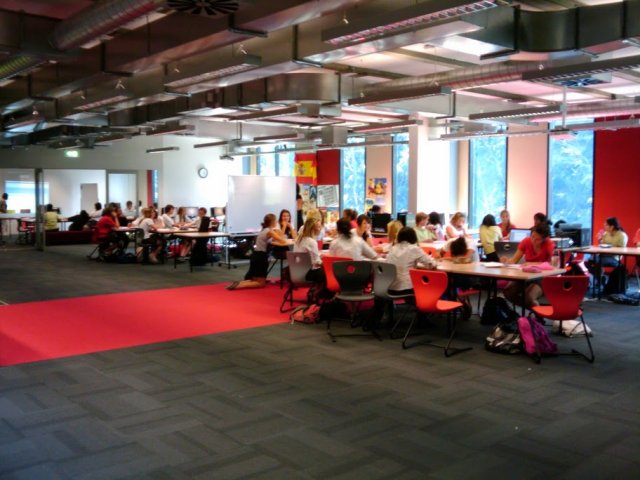
A modern learning common at an Auckland high school — New Zealand schools will benefit from $334 million in new classroom and school infrastructure under Budget 2026, part of a $559 million school property envelope, according to RNZ and NZ Herald reporting on Budget documents.
Tertiary Subsidies Frozen as Fee Cap Rises Again
Tertiary subsidy rates stay unchanged except for a 2 per cent rise on foundation courses. Providers may increase domestic fees by up to 6 per cent in 2027, the third consecutive year of such flexibility. A $284 million top-up addresses enrolment-driven under-funding, mostly in 2026 and 2027.
The Education Review Office gains $3 million per year for a Schools of Concern programme. NZQA receives $44.5 million over four years plus $31 million for technology. The Ministry of Education, Tertiary Education Commission and tertiary budgets face $37.5 million in cuts.
Major Budget 2026 Education Allocations (NZ$ million over four years)
Spending prioritises schools and vocational pathways while holding most tertiary subsidies steady.
Source: RNZ and Budget 2026 at a Glance (budget.govt.nz)
Fiscal Context and Spending Backdrop
The net operating allowance for Budget 2026 was set at $2.1 billion, reduced from the $2.4 billion ceiling signalled in December's Budget Policy Statement, according to 1News and RNZ. The package forms part of efforts to return the books to surplus earlier than previously forecast.
Core Crown education spending reached $9.95 billion for primary and secondary schools, $3.074 billion for ECE and $5.171 billion for tertiary in the year to June 2025, according to Treasury and Figure.NZ data. New Zealand's public expenditure on education stands at 5.1 per cent of GDP, above the OECD average of 4.7 per cent, according to OECD Education at a Glance 2025.
Budget 2025 delivered a $2.5 billion education package over four years focused on learning supports. The current approach reprioritises $65 million from lower-performing programmes.
Vocational Pathways and Second-Order Risks
Second-order effects include potential gains in secondary-to-tertiary transitions through expanded vocational places. Risks remain around tertiary participation if fee increases deter enrolments amid cost-of-living pressures. The emphasis on targeted spending and reprioritisation supports the government's fiscal discipline narrative.
The opposition and tertiary sector representatives had not responded to requests for comment by the time of publication. Universities New Zealand and the New Zealand University Students' Association had not issued public statements on the fees-free axing or the third consecutive 6 per cent fee-cap flexibility by publication time.