Crown seizes Waitematā crossing as $23bn fiscal test
Cabinet has pulled the additional Waitematā Harbour Crossing under direct Crown control and ordered an independent detailed business case, deferring any preferred option until funding, financing and delivery are settled against a tight balance sheet.
Auckland’s potential $5 billion Fast-track infrastructure exposure and 16,270 wrongly suspended Winter Energy Payments have become the first real-world stress tests of the Regulatory Standards Act 2025.
Cabinet’s Economic Policy Committee has formally authorised public consultation on a prudential levy to shift Reserve Bank supervision costs onto banks, insurers and market infrastructure operators from 2027/28.
Cabinet has agreed in principle to three shifts in public performance reporting sought by the Finance and Expenditure Committee, while parking detailed design and costings until 2027.
Cabinet has ordered an independently led Detailed Business Case on an additional Waitematā Harbour Crossing and placed the project under direct Crown ministerial control, Transport Minister Chris Bishop and Auckland Minister Simon Watts announced.
A globally recruited Senior Responsible Owner will report to the Ministers of Finance, Transport and Auckland, and to Cabinet. The NZ Transport Agency Board endorsed a tunnel on 15 May 2026 after completing an Investment Case. Cabinet has not adopted that preference.
Ministers say more work is required on funding, financing, delivery models and fit with the wider Auckland network before any option is locked in. The DBC phase, including a possible Meola Reef study and a market-led bridge-upgrade proposal, is targeted for completion in 2027.
The governance reset is as much a fiscal decision as an engineering one. Treasury monitoring reported by RNZ in November 2024 put Stage 1 capital for the preferred package at $22.9–$27.2 billion (50th–95th percentile). That figure covered tunnel or bridge work plus related Northern Busway, Harbour Bridge and State Highway 1 upgrades.
Waitematā crossing cost benchmarks (NZD billions)
Indicative bands; Stage 1 is Treasury 50th–95th percentile. CRL shown for scale after escalations.
Source: RNZ (Treasury monitoring report, Nov 2024); public 2023 option bands; City Rail Link cost history
Ordinary Budget capital allowances cannot absorb a multi-decade build of that scale. Budget 2026 set capital allowances at $3.5 billion a year through Budget 2029. The Treasury’s Budget Economic and Fiscal Update 2026 still shows large near-term OBEGALx deficits before a forecast return to surplus.
Cost history and escalation risk
Labour-era consultation in 2023 put multimodal options in rough bands of about $15–$25 billion. An August 2023 emerging preferred package of twin road tunnels, light rail and ancillary works was estimated at $35–$45 billion. The coalition cancelled Auckland Light Rail and narrowed the brief toward road capacity and bus-oriented public transport.
City Rail Link — previously New Zealand’s largest transport build — rose from early estimates near $2.3–$2.9 billion to about $5.5 billion by 2023. A Waitematā Stage 1 bill several times that size would dominate the Crown capital programme for years.
Bishop has described the crossing as likely the largest and most expensive infrastructure project ever undertaken in New Zealand. He has argued that megaprojects overrun on cost and time because of scale, duration and fragmented approvals — a governance problem that requires Crown direction because the Crown holds the funding levers and residual risk.
Corridor pressure and economic stakes
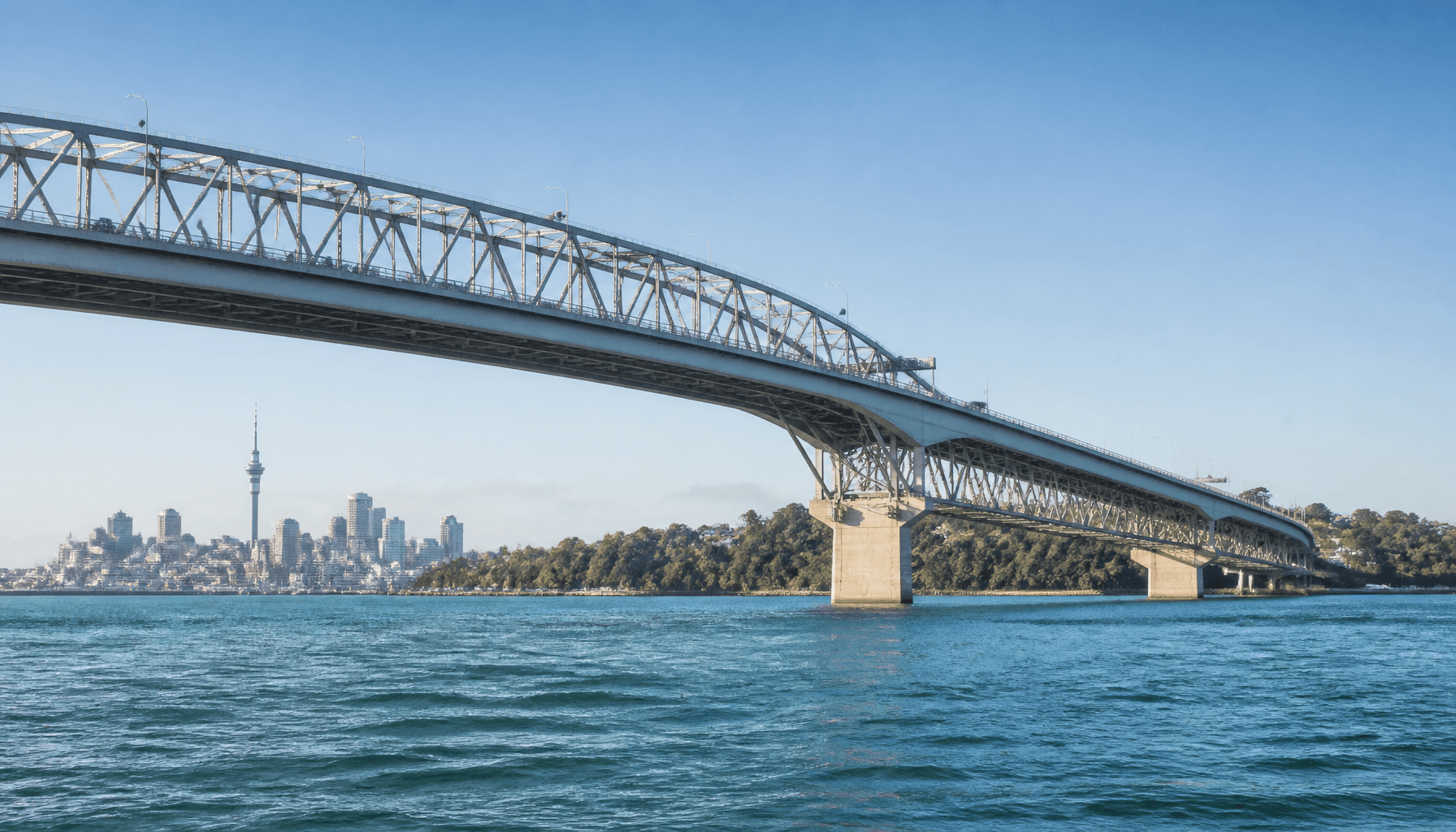
The 1959 Auckland Harbour Bridge carries about 170,000 vehicles a day on the country’s busiest state-highway corridor. Ministers say the corridor underpins almost $1 billion a year in economic activity, projected to rise to $3.9 billion by 2051.
Weight restrictions already constrain freight and buses. The Northern Busway carries about 40 per cent of people crossings but lacks dedicated lanes that would unlock more capacity. Without a second crossing, ministers put the economic cost of disruption from major renewals and extended lane closures at around $4.8 billion.
Auckland holds about a third of New Zealand’s population and a larger share of national GDP. Corridor failure is a national productivity and resilience issue, not only a local congestion problem.
Funding tools under a constrained balance sheet
The DBC must show how New Zealand pays. An NZTA market-sounding report completed in 2025 and released under the Official Information Act to The Spinoff found strong market interest and a general preference for a tunnel on risk grounds, even if more expensive.
The same report said a bridge public-private partnership was unlikely to achieve value for money if operators had to carry residual risk on the ageing existing bridge. It cited $7.5 billion as a likely upper limit for any fixed-price offer — well short of full project cost. Contractors preferred open-book incentivised target-cost models for riskier works and wanted the Crown to retain tolling ownership.
OBEGALx path (BEFU 2026)
Deficits remain large through 2026/27 before a forecast surplus in 2028/29 — the backdrop for multi-year capital commitments.
Source: The Treasury, Budget Economic and Fiscal Update 2026
The Infrastructure Commission’s 2026 National Infrastructure Plan illustrated that a $9 toll on both new and existing crossings might raise $7–$9 billion depending on the tolling period. Ministers have signalled any new crossing would be tolled. Dual tolling of the existing free bridge remains a separate, politically difficult decision.
Time-of-use congestion charging legislation enables Auckland schemes with NZTA. The DBC is instructed to consider any such scheme alongside NZTA’s Auckland Motorway Plan and the 30-year integrated transport plan under Auckland Transport governance reforms and the Auckland City Deal.
National Infrastructure Funding and Financing Limited sits on the new steering group with Treasury and NZTA. NIFF is the Crown’s shopfront for private capital into public infrastructure. Its presence underscores that ordinary appropriations will not carry the residual.
Treasury BEFU 2026 forecasts an OBEGALx deficit of $11.9 billion (2.6 per cent of GDP) in 2025/26 and $11.4 billion (2.4 per cent) in 2026/27, returning to a surplus of 0.5 per cent of GDP in 2028/29. Net core Crown debt is forecast to peak at 46.1 per cent of GDP in 2027/28. Against that path, a $23–$27 billion Stage 1 residual after user charges would pressure multi-year Budget strategies and crowd out other capital programmes if poorly staged.
Fiscal constraints vs Stage 1 capital
Stage 1 capital (mid)
~$25bn
50th–95th $22.9–27.2bn
Capital allowance/yr
$3.5bn
Budgets 2026–29
Illustrative dual toll take
$7–9bn
$9 toll scenario
Net debt peak
46.1% GDP
2027/28 forecast
Annual capital allowances and peak debt frame residual Crown exposure after illustrative toll revenue.
Cabinet agreed to commission a further independent study of a Meola Reef corridor if Auckland Council is interested. Mayor Wayne Brown has argued a reef-aligned bridge would be shorter and cheaper than NZTA alignments near the existing bridge. Ministers note Meola has been examined many times and previously discounted as unachievable. The SRO, not NZTA, would commission the study; Council would be invited to help scope and procure and to fund 50 per cent of the cost.
Officials recommended advancing a market-led proposal from an international consortium for an innovative methodology to upgrade the existing bridge, integrating it into the DBC phase.
Bishop said the Government intends to consult the Opposition and Aucklanders before endorsing an option, noting the project will span multiple Parliaments. NZTA remains central to delivery but will no longer sit at the apex of decision-making.
What 2027 must answer
The next phase buys process discipline at the price of delay. Preferred-option Cabinet decisions now sit in a 2027 window after earlier mid-2026 expectations, while renewal risk on the 1959 bridge continues to accumulate.
Before any build decision, the DBC must answer four fiscal questions in dollars and risk allocation: which option survives value engineering and geotechnical reality; how much user charging (tolls, dual tolling, time-of-use) can realistically raise without wrecking network performance; which delivery model — PPP, incentivised target cost, or hybrid — the market will actually price; and how the residual Crown commitment fits inside debt and capital-allowance paths without starving other national infrastructure.
Until those answers are on the table, New Zealand’s largest planned transport commitment remains a balance-sheet design problem first and a tunnel-or-bridge argument second.