Government Caps New Cook Strait Ferries at $1.7 Billion, Delivering $2.3 Billion Savings
The Government has capped taxpayer contributions for two new Cook Strait rail ferries at $1.7 billion, securing claimed savings of $2.3 billion compared with the cancelled Project iReX.
Auckland’s potential $5 billion Fast-track infrastructure exposure and 16,270 wrongly suspended Winter Energy Payments have become the first real-world stress tests of the Regulatory Standards Act 2025.
Cabinet’s Economic Policy Committee has formally authorised public consultation on a prudential levy to shift Reserve Bank supervision costs onto banks, insurers and market infrastructure operators from 2027/28.
Cabinet has agreed in principle to three shifts in public performance reporting sought by the Finance and Expenditure Committee, while parking detailed design and costings until 2027.
The Government has capped taxpayer contributions for two new Cook Strait rail ferries at $1.7 billion, securing claimed savings of $2.3 billion compared with the cancelled Project iReX.
Minister for Rail Winston Peters announced on 17 July 2026 that KiwiRail will operate the vessels named Kupe and Cook. The ferries are scheduled to arrive in 2029 for a 30-year operating life, with a review in 2039.
This arrangement keeps rail freight integrated across the strait. It supports the critical Auckland to Christchurch supply chain.
Cook Strait ferries at Picton terminal — the route the new vessels Kupe and Cook will serve from 2029 under KiwiRail's 30-year operating mandate. Photo: jokertrekker · CC BY 3.0 · Wikimedia Commons
Cost Comparison
Project iReX costs escalated sharply under the previous government. Original estimates stood at $1.45 billion in the 2021 detailed business case. Costs reached $2.609 billion by 2023. Treasury warned they could approach $4 billion.
The programme was cancelled with $671 million in sunk costs. These included $222 million paid to the shipbuilder and $449 million on landside works, planning and wind-down.
The new programme limits taxpayer exposure to $1.7 billion. It includes a fixed-price contract with Guangzhou Shipyard International. Ship construction starts in 2027.
Cook Strait Ferries Cost Comparison
Milestone
Estimated Cost (NZ$ billion)
iReX 2021 DBC
1.45
iReX 2023 Update
2.609
Treasury Warning
4
iReX Sunk Costs
0.671
New Programme Cap
1.7
New programme caps exposure well below prior trajectory
Source: Treasury Report T2023/1904 and government announcements
Infrastructure Funding Model
CentrePort will contribute $100 million and Port Marlborough $110 million to marine infrastructure. Both ports will earn commercial returns through fees paid by KiwiRail.
Ferry Holdings, a Crown special purpose vehicle, will fund $373 million of complex Picton works. A new entity will co-own those assets with Port Marlborough.
KiwiRail will pay commercially priced port fees to CentrePort, Port Marlborough and Ferry Holdings. CentrePort and Port Marlborough will earn a reasonable return on their $100 million and $110 million contributions respectively.
KiwiRail will pay market-based port fees. The operator has already lifted Interislander reliability to 98 percent in FY25. Cancelled sailings fell 40 percent year on year. KiwiRail is on track for a $160 million earnings target by June 2026.
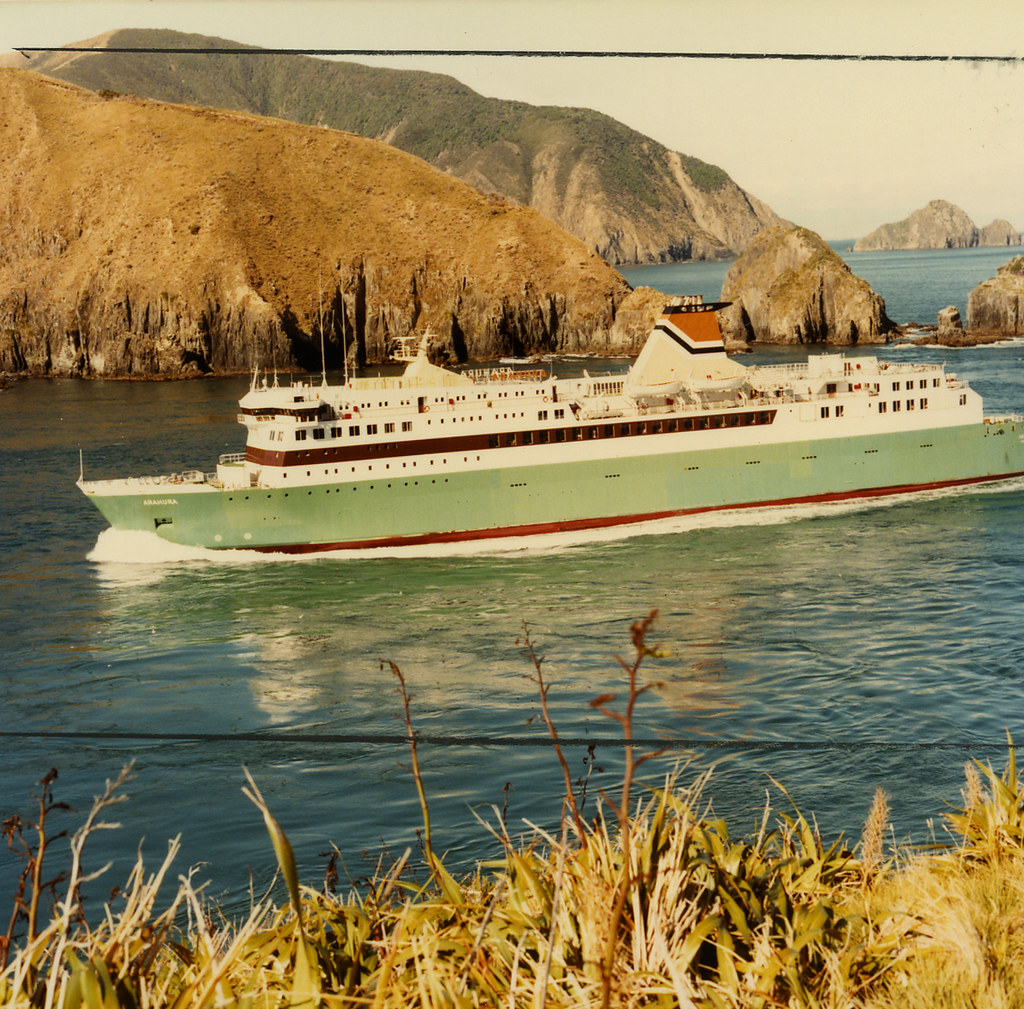
A Cook Strait ferry navigates the Marlborough Sounds toward Picton — the southern terminus where Ferry Holdings will fund $373 million in new infrastructure under the revised programme. Photo: Archives New Zealand · CC BY 2.0 · Flickr
Delivery Risks and Controls
A Treasury Gateway review found that planning had proceeded in a back-to-front sequence, leaving the project exposed to risks of delays and higher costs if design and port agreements slipped past mid-2026 milestones.
The Government emphasises fixed-price contracts, no cost-plus arrangements, and performance incentives. Ferry Holdings retains major control rights and holds the purse strings.
The 30-year operating horizon allows KiwiRail to build reserves for replacements in 2059. This provides long-term certainty absent from the iReX era.
According to Treasury, the Cook Strait carries roughly 40 percent of road freight volumes, 100 percent of rail freight, and 70 percent of passengers between the islands. Reliable service underpins national logistics costs for businesses and households.
The commercial structure and port co-investment reduce pressure on Crown debt-to-GDP while preserving rail freight competitiveness.