MPI Begins Statutory Review of Dairy Industry Restructuring Act
Agriculture Minister Todd McClay announced on 19 May 2026 that the Ministry for Primary Industries has published the terms of reference for the statutory review of the Dairy Industry Restructuring Act 2001.
Regulation and Markets Conduct Reporter · 20/05/2026 · 08:39 NZT · 6 min read
"The review will examine whether the DIRA's current competition provisions that regulate Fonterra remain necessary, fit-for-purpose, and achieve net benefits for our dairy sector."Todd McClay, Agriculture Minister
Auckland’s potential $5 billion Fast-track infrastructure exposure and 16,270 wrongly suspended Winter Energy Payments have become the first real-world stress tests of the Regulatory Standards Act 2025.
Cabinet’s Economic Policy Committee has formally authorised public consultation on a prudential levy to shift Reserve Bank supervision costs onto banks, insurers and market infrastructure operators from 2027/28.
Cabinet has agreed in principle to three shifts in public performance reporting sought by the Finance and Expenditure Committee, while parking detailed design and costings until 2027.
Agriculture Minister Todd McClay announced on 19 May 2026 that the Ministry for Primary Industries has published the terms of reference for the statutory review of the Dairy Industry Restructuring Act 2001.
The review will test whether the Act's special competition rules for Fonterra remain necessary, fit for purpose and deliver net benefits to the sector. It must report to Parliament by 1 June 2027 after two rounds of public consultation.
"The review will examine whether the DIRA's current competition provisions that regulate Fonterra remain necessary, fit-for-purpose, and achieve net benefits for our dairy sector." — Todd McClay, Agriculture Minister
The current review will assess whether the provisions should be retained, repealed or amended.
A regime built for a 96% market share
The Dairy Industry Restructuring Act was enacted in 2001 to facilitate the merger that created Fonterra. At formation Fonterra collected 96 percent of New Zealand's bovine milk solids. The Act added open entry and exit rules for farmer suppliers, regulated milk access for rival processors and transparency requirements around the farmgate milk price. These provisions sit above the general competition rules in the Commerce Act 1986.
Fonterra's market share has since declined to above 70 percent in recent seasons. Previous DIRA reviews examined environmental impacts, land use change and whether Fonterra's dominance still warranted tailored rules.
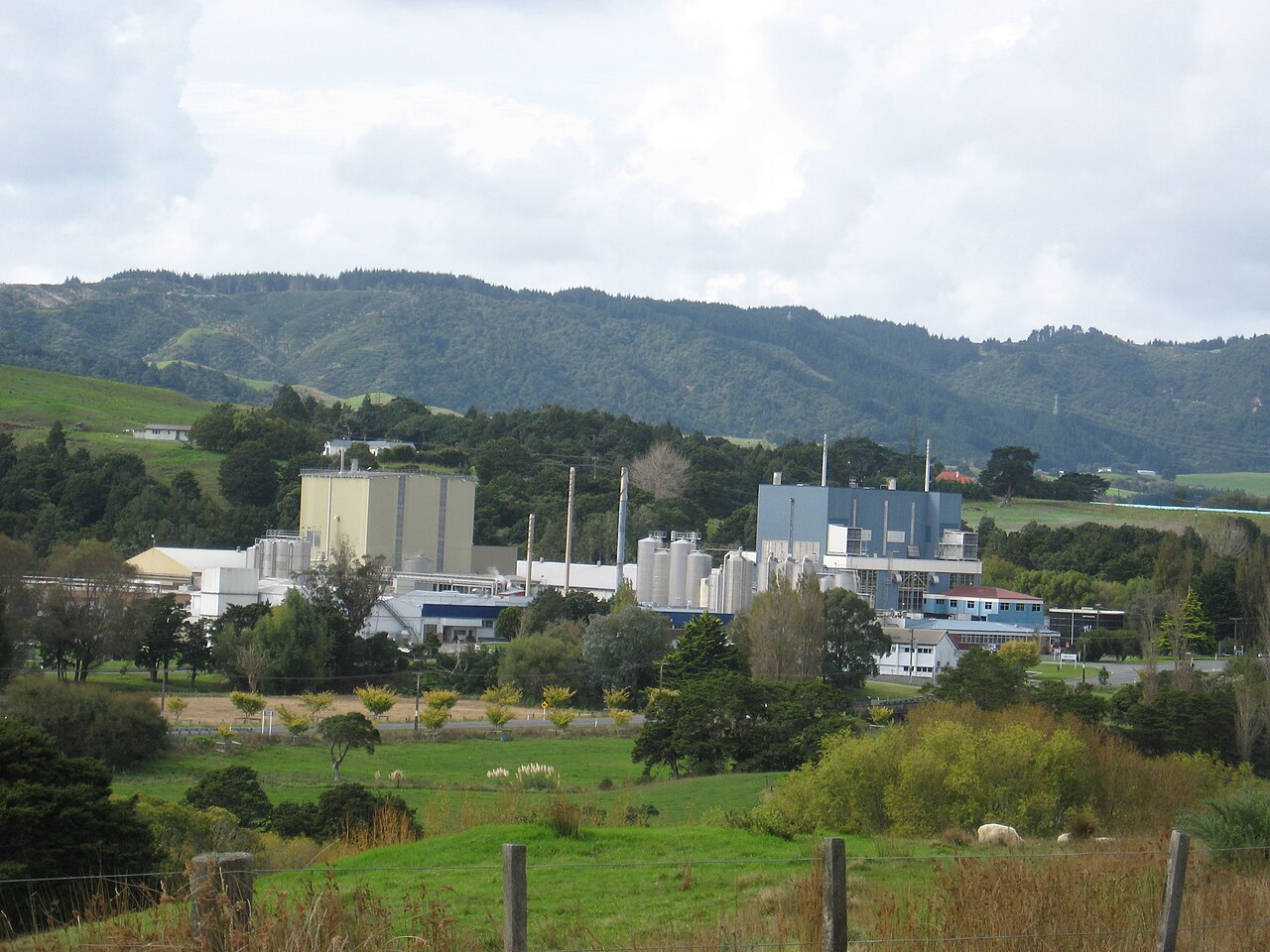
Fonterra's Maungaturoto processing plant — one of many facilities whose regulatory settings are under review as MPI examines whether DIRA's bespoke competition rules remain fit for purpose. Elizabeth Clark · CC BY-SA 3.0 · Wikimedia Commons
Record exports, deep regional stakes
New Zealand dairy exports reached a record $27.15 billion in the year to June 2025. Revenue is forecast to rise to $27.4 billion in the year to June 2026. The sector employs just under 55,000 people and supports roughly 8,000 to 10,000 dairy farmer shareholders.
NZ Dairy Export Revenue
Record 2024/25 earnings and MPI forecast for 2025/26.
Source: MPI Situation and Outlook for Primary Industries; Farmers Weekly
Commerce Commission's parallel oversight role
The Commerce Commission conducts two statutory reviews each season of Fonterra's Milk Price Manual and base milk price calculation. It must report by 15 September each year on whether the processes support efficiency and contestability.
Fonterra materials highlight stable transparent milk prices and global market access for farmers. Industry commentary notes efficiency gains from scale while stressing the need to preserve farmer choice and new entrant opportunities.
Regional and macroeconomic implications
Regional economies in Waikato, Canterbury, Bay of Plenty and Southland could see second-order effects from any changes to processing competition or investment signals. Treasury and MPI forecasts already assume dairy's $27-plus billion export contribution. Any regulatory shift could influence farmgate returns, processor margins and export competitiveness over the next 12 to 24 months.