New Zealand-India Free Trade Agreement Delivers Modest Near-Term Gains, Focuses on Long-Term Positioning
The New Zealand Institute of Economic Research states that the free trade agreement with India functions primarily as strategic positioning in a fragmented global economy rather than an immediate export booster.
"Being there matters. Trade agreements create platforms for future opportunities, not just immediate market access gains."Chris Nixon, Principal Economist, NZIER
New Zealand rural confidence stayed positive for a ninth straight quarter in August 2026, with horticulturalists overtaking sheep and beef as the most optimistic sector while investment plans stayed soft.
Parliament passed the India Free Trade Agreement legislation 93–29 on 16 September 2026. Preferential tariffs await mutual ratification, with Indian officials pointing to mid-to-late October entry into force.
Electric vehicles on New Zealand roads have avoided about $90 million in oil-product imports since the start of 2024, a Newsroom analysis estimates, as Stats NZ reported fuel led the rise in merchandise imports in the year to July 2026.
The New Zealand Institute of Economic Research states that the free trade agreement with India functions primarily as strategic positioning in a fragmented global economy rather than an immediate export booster.
NZIER Analysis Frames Deal as Long Game
The New Zealand Institute of Economic Research released Insight 128 on 17 June 2026. It describes the New Zealand-India Free Trade Agreement as a platform for future opportunities. The deal liberalises tariffs on 95 percent of New Zealand's current exports to India. Fifty-seven percent gain immediate duty-free access on entry into force.
This approach aligns with New Zealand's need to diversify beyond heavy reliance on China, Australia and the United States. Two-way trade reached NZ$3.95 billion in the year to December 2025. New Zealand recorded a modest surplus driven by services and forestry.
NZIER principal economist Chris Nixon wrote that too much focus is placed on tariff reductions and early trade benefits. Nixon said:
“Being there matters. Trade agreements create platforms for future opportunities, not just immediate market access gains.” — Chris Nixon, Principal Economist, NZIER
NZIER said the value of the agreement lay in building long-term relationships, improving regulatory engagement, and creating a platform for future opportunities, rather than delivering a sharp lift in trade straight away.
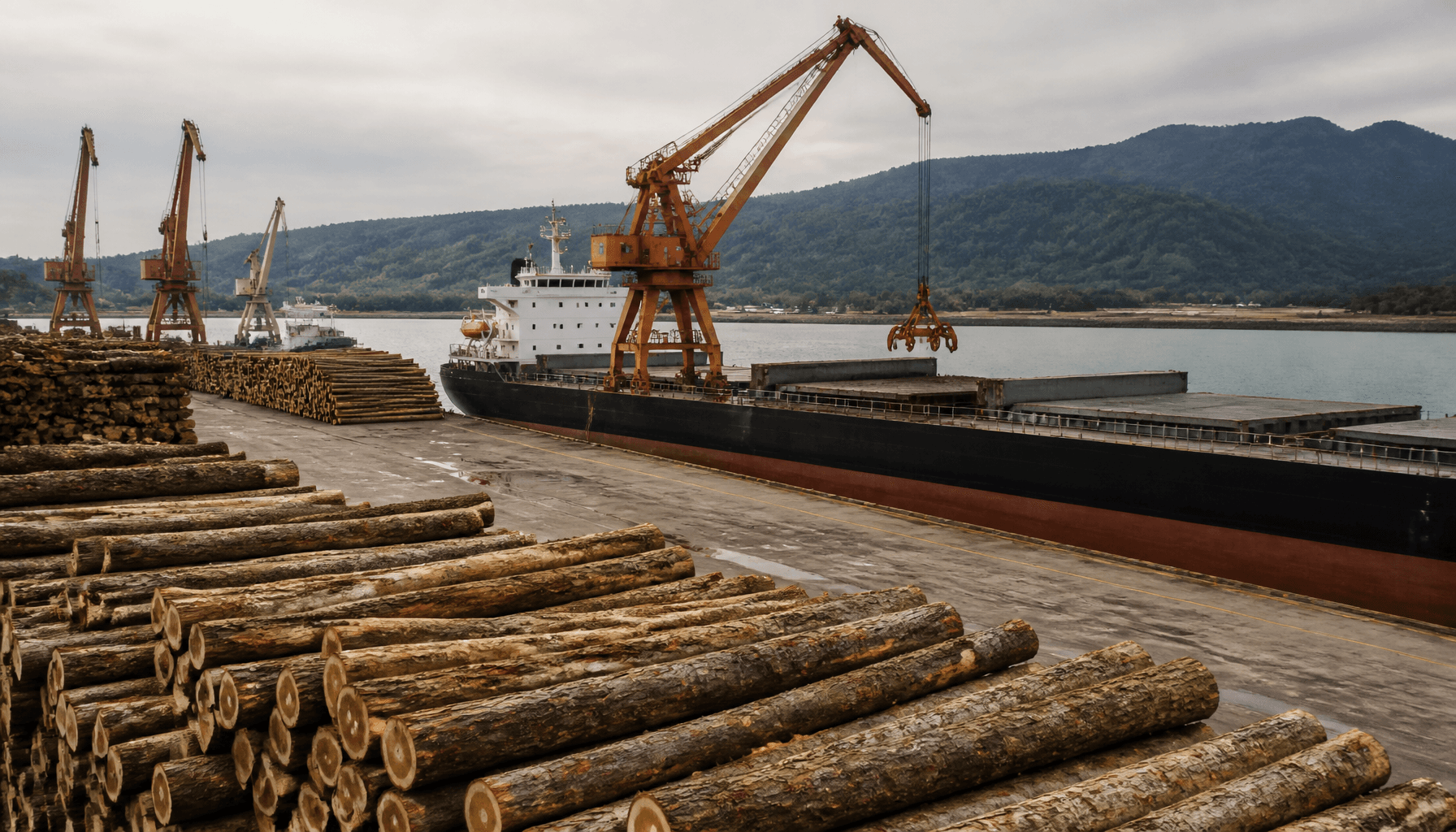
AI illustration of New Zealand export produce — forestry logs, kiwifruit and apples — at a working port wharf. Forestry, horticulture and sheepmeat are among the sectors set to gain immediate tariff-free access to India under the FTA.
Tariff Reductions by Sector
Immediate zero-duty access applies to sheep meat, wool, coal and over 95 percent of forestry exports. Seafood tariffs phase out over seven years. New quota access opens for kiwifruit and apples. Wine tariffs fall 66 to 83 percent over ten years. Mānuka honey sees 75 percent cuts.
New Zealand grants immediate zero-duty access on all Indian goods. This creates an asymmetric opening. Dairy remains largely excluded due to Indian sensitivities. Limited fast-track mechanisms exist for certain ingredients.
A column chart follows the initial analysis of projected impacts.
Projected GDP Impact of NZ-India FTA
Near-term effects remain small while longer-horizon gains accumulate through diversification and services growth.
Source: Motu Economic Impact Assessment, February 2026
Trade-Offs and Compliance Costs
Initial tariff savings total approximately NZ$43 million on day one and rise to NZ$62 million. The average applied tariff on New Zealand exports drops to around 3 percent. Exporters must verify rules of origin aligned with existing agreements.
These compliance requirements add administrative burden for small and medium enterprises. The ratification process involves Select Committee review, public submissions and omnibus legislation. NZ First opposition may extend timelines and increase taxpayer costs associated with parliamentary processes.
Government modelling from Motu projects New Zealand goods and services exports to India rising NZ$339.9 million or 16.3 percent in 2027 relative to baseline. By 2050 the increase reaches NZ$1,271.6 million or 25 percent. GDP lifts remain small at NZ$135 million or 0.03 percent in 2027 and NZ$657.7 million or 0.10 percent by 2050.
Historical Comparisons Show Gradual Benefits
The New Zealand-China FTA delivered initial annual tariff savings of around NZ$115 million. Trade volumes quadrupled afterward. The CPTPP produced estimated annual savings of NZ$222 million, according to MFAT's CPTPP National Interest Analysis. Australia's ECTA with India eliminated tariffs on more than 85 percent of Australian goods exports immediately.
Covered Australian exports surged 190 percent in the first year despite a headline decline linked to coal prices. Bilateral merchandise trade doubled to approximately US$24 billion by 2023-24. These precedents indicate that full effects emerge over years rather than months.
Second-Order Effects and Diversification
The agreement reduces exposure to a narrow set of major trading partners. Services chapters, education exports and investment provisions offer additional channels. Movement of natural persons provisions may support tourism and professional flows.
Regulatory cooperation mechanisms provide platforms to address non-tariff measures over time. Supply-chain resilience improves through broader partner networks. These elements matter more than headline tariff cuts in an era of geopolitical fragmentation.
Counter-Arguments and Evidence Assessment
Critics note the modest 0.03 percent GDP effect in 2027 and the exclusion of dairy. Benefits appear concentrated in services and long-horizon positioning rather than immediate goods transformation. NZ First has voiced opposition, citing concerns over the negotiation process.
Evidence from the Motu assessment and NZIER analysis supports the view that relationship-building and market access platforms outweigh short-term numerical gains. Diversification carries value even when near-term GDP increments stay small. Exporter groups including Zespri, Beef + Lamb New Zealand and Federated Farmers signed letters calling the deal a strategic necessity.
Open Questions on Ratification and Uptake
Parliamentary processes continue with Select Committee examination underway. Public submissions closed around May 2026. The omnibus bill faces potential delays from political opposition. Actual export uptake may fall short of modelling if non-tariff measures or compliance costs prove higher than anticipated.
Services and investment chapter activation speed remains uncertain. Forestry, horticulture and meat sectors stand to lead initial goods gains. Whether these offset regulatory adjustment costs for smaller operators requires monitoring.
Forward Outlook
Businesses should prepare using the MFAT Tariff Finder and rules-of-origin guidance ahead of entry into force. Ratification timing will determine the precise start of tariff reductions. Continued monitoring of Indian market growth and New Zealand export responses will clarify the deal's contribution to economic resilience over the coming decade.