OECD Flags Lending Gap Holding Back New Zealand SMEs
New Zealand banks channel only 18 per cent of lending to businesses excluding agriculture, well below the 30 per cent share recorded in Australia at the same point.
Regulation and Markets Conduct Reporter · 21/05/2026 · 06:11 NZT · 6 min read
"The non-performing share of business loans has increased, but is still low compared to previous downturns."Reserve Bank of New Zealand, Financial Stability Report November 2025
Auckland’s potential $5 billion Fast-track infrastructure exposure and 16,270 wrongly suspended Winter Energy Payments have become the first real-world stress tests of the Regulatory Standards Act 2025.
Cabinet’s Economic Policy Committee has formally authorised public consultation on a prudential levy to shift Reserve Bank supervision costs onto banks, insurers and market infrastructure operators from 2027/28.
Cabinet has agreed in principle to three shifts in public performance reporting sought by the Finance and Expenditure Committee, while parking detailed design and costings until 2027.
New Zealand banks channel only 18 per cent of lending to businesses excluding agriculture, well below the 30 per cent share recorded in Australia at the same point.
Banks allocated NZ$128 billion to business lending excluding agriculture as of December 2024. Housing absorbed around 60 per cent of total bank lending over the same period.
This allocation leaves most small manufacturers, trades firms and food producers reliant on high-cost alternatives or personal guarantees.
Business lending as share of total bank lending
New Zealand versus Australia, December 2024 comparable period.
Source: NZBA Banking Industry Facts and Figures 2024; OECD Economic Surveys: New Zealand 2026
Prudential settings and the housing tilt
Reserve Bank prudential settings and capital rules have reinforced the tilt toward housing assets.
The OECD report notes that even the Business Finance Guarantee Scheme, which ended on 30 June 2021 with the Crown taking up to 80 per cent of default risk, failed to shift bank underwriting practices. According to the Treasury's published documentation on the scheme, participating banks continued to require personal guarantees or property security in many cases.
The Reserve Bank of New Zealand noted in its November 2025 Financial Stability Report that while the non-performing share of business loans had increased, it remained low compared to previous downturns. Low default rates have, however, come at the expense of broader credit access.
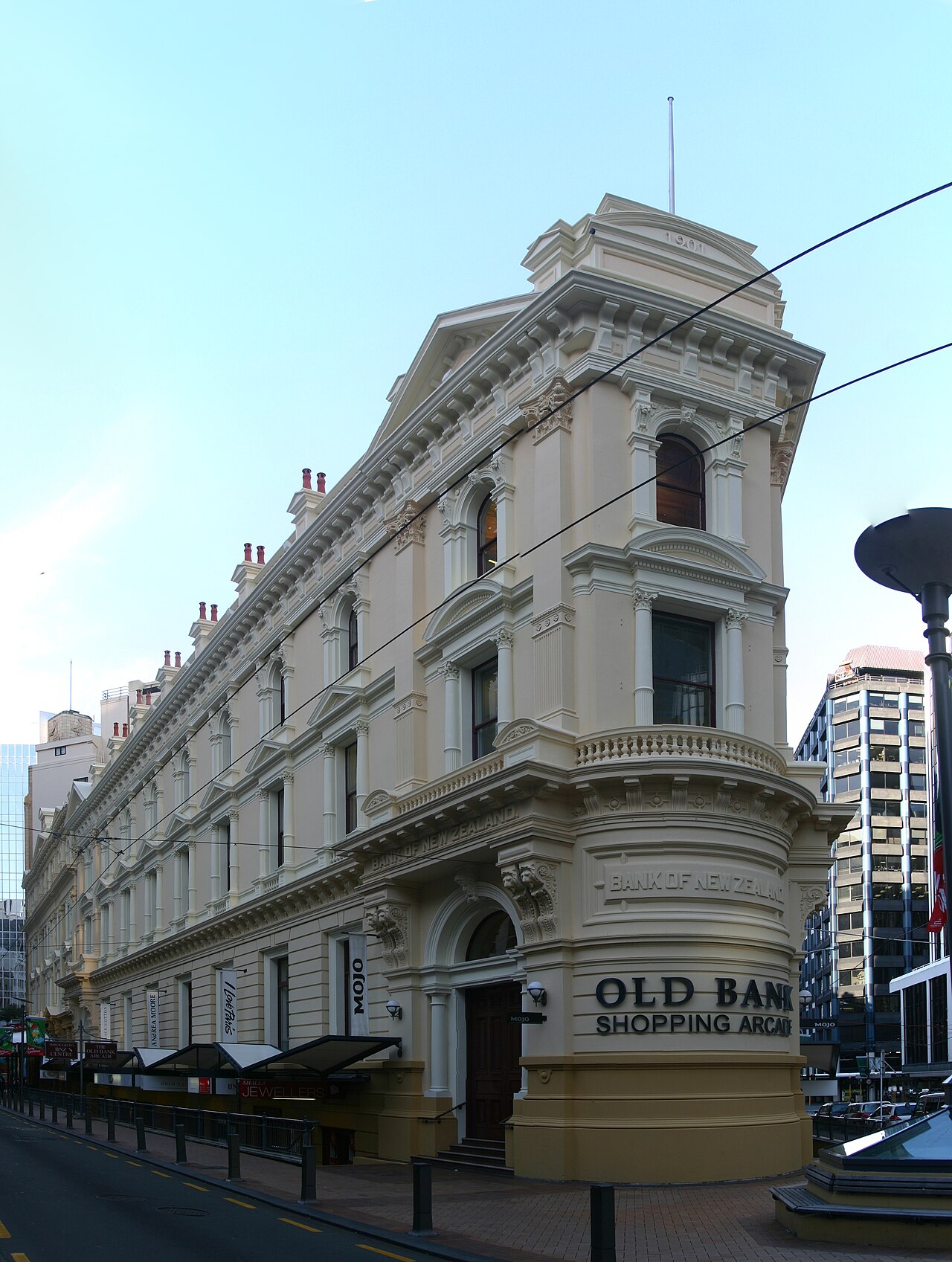
The BNZ Building on Lambton Quay, Wellington. The four major banks — ANZ, ASB, BNZ and Westpac — hold the bulk of New Zealand's NZ$128 billion business loan book, yet direct only 18 per cent of total lending to business, against 30 per cent in Australia.
Venture capital growth masks the missing middle
Venture capital has grown strongly for high-growth tech firms, reaching nearly NZ$600 million in 2024 from NZ$50 million in 2015.
Most SMEs never access equity markets and require debt products instead.
The OECD recommends a national pooled SME loan securitisation platform, a credit register and streamlined private placements to widen funding options. It also calls for revenue-based finance, export working-capital guarantees and SME-friendly procurement rules.
Literacy, productivity and the reform path
New Zealand records high general financial literacy yet lacks a dedicated national programme for SMEs on cash-flow management and pricing.
Productivity growth stays below the OECD average, with capital intensity lagging peers such as Australia and Sweden.
The survey projects GDP growth of 1.4 per cent in 2026 and 2.3 per cent in 2027 if capital-market depth improves.
Over the next three to five years, targeted reforms to ease collateral requirements could free bank capacity for productive lending while reducing pressure on household balance sheets.
Market-led solutions such as securitisation and private placements offer a lower-burden path than further regulatory layering.
The four major banks — ANZ, ASB, BNZ and Westpac — and the Reserve Bank of New Zealand were not available for comment at the time of publication.