Unison Warns Napier Rates Shift Will Lift Electricity Bills
Unison Networks has warned Napier City Council that its proposed shift to a capital-value transportation rate will raise electricity and telecommunications charges for Napier residents.
Regulation and Markets Conduct Reporter · 26/05/2026 · 15:36 NZT · 8 min read
"Under the cost reflective pricing principles we operate by, any new council rates levied on our network are a cost specific to Napier residents. The result is that Napier residents may pay higher electricity (and/or telecommunication) charges compared to consumers in other districts purely because of this additional charge."Unison Networks
Auckland’s potential $5 billion Fast-track infrastructure exposure and 16,270 wrongly suspended Winter Energy Payments have become the first real-world stress tests of the Regulatory Standards Act 2025.
Cabinet’s Economic Policy Committee has formally authorised public consultation on a prudential levy to shift Reserve Bank supervision costs onto banks, insurers and market infrastructure operators from 2027/28.
Cabinet has agreed in principle to three shifts in public performance reporting sought by the Finance and Expenditure Committee, while parking detailed design and costings until 2027.
Unison Networks has warned Napier City Council that its proposed shift to a capital-value transportation rate will raise electricity and telecommunications charges for Napier residents.
Unison Networks told Napier City Council the change lacks evidence and will shift roading costs onto utility customers.
The lines company operates under cost-reflective pricing rules overseen by the Commerce Commission. Any extra rates on its Napier network assets become a local cost passed straight through to customers.
Napier City Council wants to remove transportation costs from the general rate, currently based on land value. Those costs make up just over 22 percent of the general rate.
The Proposed Targeted Rate
The preferred option introduces a dedicated Transportation Targeted Rate assessed on capital value. Commercial and utility properties face a 2.6 differential. Rural properties face a 0.85 differential.
Council documents state the overall rates revenue will rise 8.8 percent on average for 2026/27.
Unison submitted that the proposal is unjustified and unsupported by evidence. It described the plan as an inequitable relocation of roading costs onto utility consumers.
Under the cost reflective pricing principles we operate by, any new council rates levied on our network are a cost specific to Napier residents. The result is that Napier residents may pay higher electricity (and/or telecommunication) charges compared to consumers in other districts purely because of this additional charge.
Unison's Scale and Regulatory Position
Unison is 100 percent owned by the Hawke's Bay Power Consumers' Trust. It runs the electricity network across Hawke's Bay, Taupō and Rotorua. The company serves about 120,628 connections and holds a regulatory asset base of $951 million.
The Commerce Commission regulates Unison under Part 4 of the Commerce Act. It sets revenue caps and requires information disclosure on pricing. Local authority rates on network assets count as operating costs recoverable through lines charges.
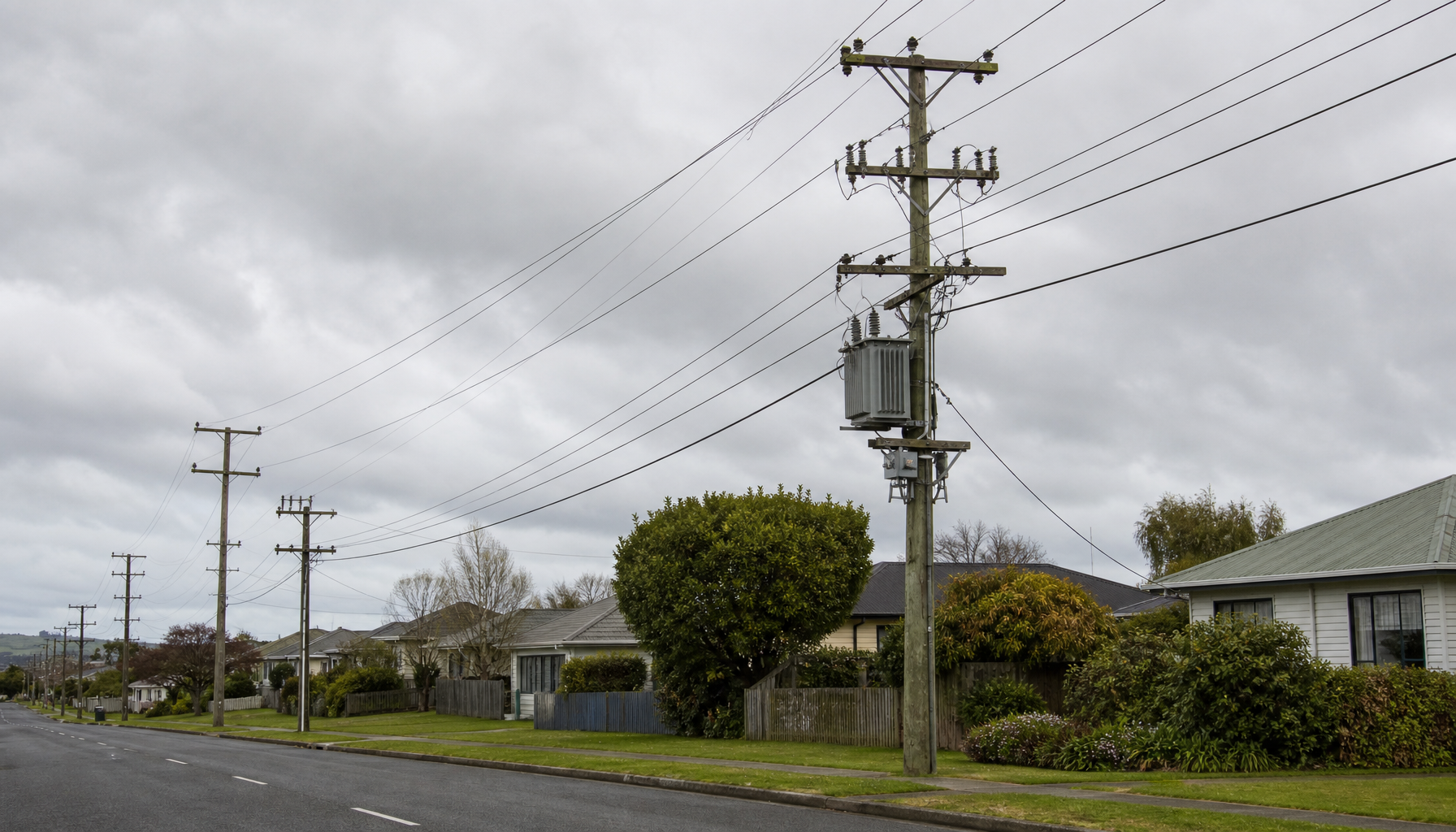
AI illustration of the kind of electricity distribution infrastructure Unison Networks operates across Hawke's Bay — assets whose council rates costs the company says will be passed through to Napier consumers under the proposed targeted rate.
Submissions and Hearings
Council officers recommended proceeding with the targeted rate. A third option to apply capital value to all rates was added later.
The council received 157 submissions opposing the roading proposal and 64 supporting it. Hearings are set for 27 and 28 May 2026. Final adoption is due by 30 June 2026.
Mayor Richard McGrath said the change offers a fairer way to calculate roading costs. Properties with high capital values but low land values would contribute more.
Napier roading rate submissions: for vs against
Consultation closed 24 April 2026 after 221 total submissions on the roading proposal.
Source: Napier City Council Annual Plan 2026/27 consultation
The Oversight Gap
Unison's submission highlights a gap in oversight. The Commerce Commission does not directly regulate the incidence of local rates on distributors. Pass-through decisions sit with the company subject to regulatory scrutiny.
Similar rating shifts could affect other lines companies nationwide. Distributors may seek recognition of such costs in future price resets.
The episode shows how local fiscal decisions can influence prices for essential services without central coordination. Napier consumers would face higher bills than peers in districts without equivalent utility rate hikes.
No independent economic analysis of consumer impacts appears in the public consultation documents. Broader trends show more councils adopting targeted rates on capital value.
The outcome in Napier may set a precedent as infrastructure pressures and three-waters reforms continue to shape local rates policy.