The Trade-offs
Compact growth reduces long-term infrastructure costs per dwelling. It also constrains near-term housing supply in a city facing acute affordability pressures. Councillor Richard Hills has advocated excluding residential projects lacking supporting infrastructure. This approach trades lower future network bills for slower land release and higher short-run construction costs from density requirements.
Rapid gas phase-out carries supply-gap risks. Energy Resources Aotearoa warns that forced switching without new domestic or import capacity risks rationing. EECA pathways show 46 percent displacement is viable, yet 54 percent of industrial energy may remain on gas under best-case voluntary uptake. The LNG backstop remains relevant through the planning horizon.
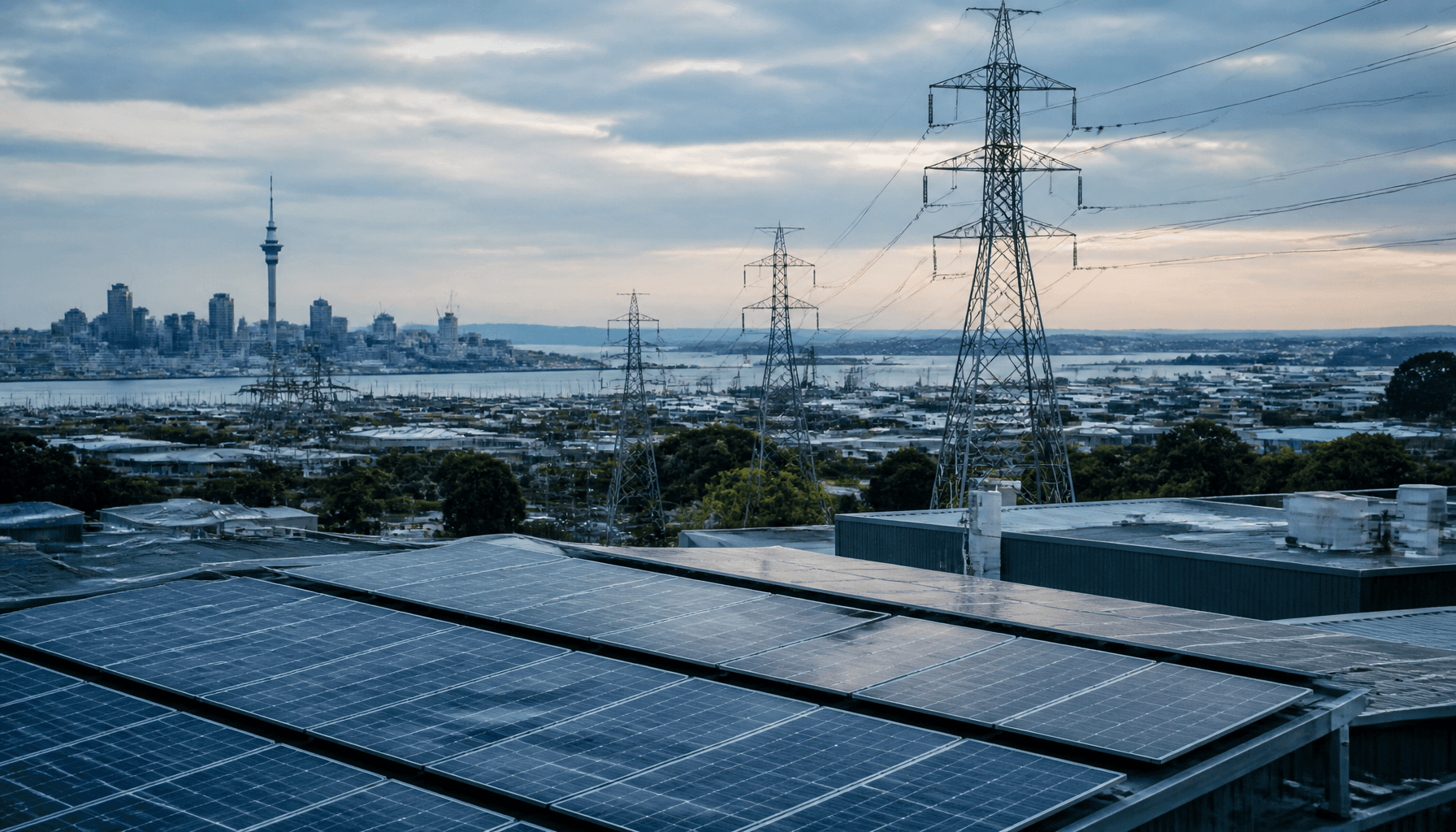
Distributed solar and demand flexibility lower network throughput. Vector's regulated revenue model recovers fixed costs over fewer units, potentially raising per-unit charges for non-solar customers. The Commerce Commission's pricing regime will determine whether savings flow to consumers or are retained as returns.
Council capital reallocation requires upfront spending on planning and zoning reform. Against $15.5 billion net debt and recent 7.9 percent rates rises, fiscal headroom remains limited even when net present value appears positive. The central government scheme offsets some business switching costs, yet council enablement expenses stay only partially quantified.
It's not just about roads and pipes, we actually have to think about how we're planning our energy future, and the fact that a lot of money has got to be spent on lines and the infrastructure of energy into the future.
Second-order Effects
Realised savings could stabilise rates and lines charges for Auckland households and businesses. Even partial delivery of the $17 billion figure would ease cost-of-living pressures and support business competitiveness.
Reduced Auckland gas dependence would ease pressure on Transpower's upper North Island assets. Wholesale price spikes that pass through to food processing and manufacturing inflation would moderate.
Changes in Auckland's borrowing and capex profile would register in Treasury local government monitoring. RBNZ inflation models would capture any shift in construction-sector demand.
Reliable energy pricing supports investment attraction. Mayor Wayne Brown has stated:
Everything we want for the city runs on reliable, fairly-priced energy - this includes jobs, new industries, affordable homes, investment and our way of life. We need a practical path that will make the most of the infrastructure and resources we already have, to avoid unnecessary costs and deliver more value for Aucklanders.
Conversely, LNG-priced gas from 2028 without viable alternatives could disadvantage Auckland relative to Australian hubs that pursued similar integrated planning.
Auckland's emissions sit 13 percent below the 2016 baseline. Transport remains the largest source. Compact growth and public transport address this driver, though the fiscal and resilience case leads the report's framing.
Historical Context
California mandated integrated resource planning after the 2000-2001 electricity crisis. Demand-response programmes displaced an estimated 2,000 megawatts of peaker plant investment by 2015. Regulatory mandate or financial incentives proved necessary to overcome dispersed users' preference for supply certainty.
South Australia's Home Battery Scheme and Virtual Power Plant aggregation showed distributed assets can provide grid services at lower cost than augmentation. Realisation required explicit government co-investment and business models that took five to seven years to mature. Auckland's 2026-2035 window mirrors this timeline.
The Netherlands accelerated Groningen field closure from 2018. Industrial users faced forced electrification or fuel switching faster than market signals alone would have prompted. Capital expenditure rose for large users, yet supply-chain development for heat pumps accelerated. New Zealand's decline is market-driven rather than policy-driven, but the pressure on users is comparable.
The Counter-Argument
Industry voices emphasise gas's ongoing role as electricity backstop. Rapid forced switching risks supply gaps without new capacity. National gas-user surveys cite uncertainty over future supply and rationing as larger barriers than finance. Auckland's 195 industrial sites face credible exposure under any accelerated timeline.
The report's emphasis on compact growth intersects with fast-track housing consenting. Projects approved on infrastructure grounds may conflict with council preferences for density. Housing supply constraints carry their own affordability costs that the $17 billion figure does not offset.
Vector's $5.4 billion network programme already targets smart metering at 95 percent coverage by 2031. Existing asset maximisation through flexible tariffs may deliver many savings without additional council planning mandates. Market signals and voluntary uptake could achieve substantial portions of the modelled outcomes. Vector chief executive Chris Blenkiron has pointed to the resilience benefit of electrification, noting that New Zealand's electricity is sourced from hydro dams, wind turbines and rooftop solar, and that
the more we can electrify, the more resilience we build into the energy system itself, and that's, as proven, a very good thing.
Open Questions
- What share of the $17 billion saving accrues directly to Auckland Council's balance sheet versus private businesses and households? What upfront co-investment does the council require to unlock each dollar of avoided cost?
- How does Vector's regulatory pricing settlement treat avoided augmentation savings? Do they flow to lower lines charges or remain with shareholders?
- What is the contractual timeline for LNG import infrastructure? What supply-gap scenario emerges if field decline outpaces both LNG readiness and electrification uptake in 2027-2029?
- Does the EECA 46 percent displacement figure assume existing electricity network capacity in industrial corridors? Or does it include grid reinforcement costs required at scale?
- How does the compact-growth prescription interact with the government's fast-track housing regime? Projects approved on infrastructure grounds may proceed despite council density preferences.
Forward Outlook
Auckland Council faces a concrete choice between reactive infrastructure spending and disciplined planning. The $17 billion figure provides a fiscal benchmark. Delivery depends on zoning reform execution, Vector's pricing settlement, and voluntary business responses rather than mandates. Rates payers and businesses will track whether avoided costs materialise as lower charges or remain aspirational. The next Vector regulatory review and council long-term plan update will reveal the trajectory.