Cabinet locks in pre-election ban on public-service party policy costings
Cabinet has reaffirmed New Zealand’s long-standing self-denying ordinance: public service agencies will not cost political party policies for party-political purposes in the run-up to the 7 November 2026 election.
Labour says it has costed a full-term fuel excise freeze but will not publish the numbers until after Treasury’s Pre-election Economic and Fiscal Update on 29 September, leaving National’s $4.6 billion NLTF shortfall claim unanswered in the open.
New Zealand’s 10-year government bond yield sat at 4.78% in early September 2026, matching the US Treasury 10-year while the OCR was only 2.75% after the Reserve Bank’s 25 basis point hike. Global term premium, AI-sector debt supply and Middle East fuel inflation have already lifted wholesale, swap and fixed mortgage pricing ahead of Wellington’s calm central track toward about 3.2%.
NZ Transport Agency has recalculated Funding Assistance Rates for the 2027–30 National Land Transport Programme, stepping down co-investment for more than a dozen councils and shifting multi-million-dollar local-road costs onto thin rural rate bases just as rates-band discipline begins.
Cabinet has reaffirmed New Zealand’s long-standing self-denying ordinance: public service agencies will not cost political party policies for party-political purposes in the run-up to the 7 November 2026 election.
Cabinet on 11 August 2026 agreed to continue the practice of not requesting public service agencies to cost political party policies ahead of the general election.
The decision is recorded in Cabinet Minute CAB-26-MIN-0248, proactively released by Finance Minister Nicola Willis. Cabinet noted that successive governments have maintained the practice since 1996.
Day-to-day government costings can continue. That covers Budget proposals, Cabinet papers, business cases and financial veto work. Any request that may conflict with the ordinance must go to the Minister of Finance's office.
Treasury guidance updated on 7 September 2026 confirms the rule. It cites CAB-26-MIN-0248 and labels the practice a “self-denying” ordinance. The guidance applies through the pre-election period.
Prime Minister Christopher Luxon announced on 21 January 2026 that the election will be held on Saturday 7 November. Parliament is to dissolve on 1 October, with Writ Day on 4 October and advance voting from 26 October.
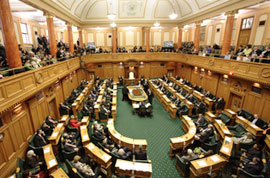
Parliament's chamber, where the Cabinet Manual's rules on ministerial requests for official advice are meant to keep departmental analysis out of party-political costings.
The ordinance sits inside Cabinet Manual norms. Ministers must ensure requests for official advice serve portfolio duties, not party-political purposes.
The rejected costings unit
In June 2025 the Expenditure and Regulatory Review Committee considered a Willis proposal for a small Public Service Commission unit. The unit would have taken costing requests from recognised parties from eight months before polling day until ten working days before it. Departments would prepare numbers independent of ministers and return them confidentially.
EXP-25-MIN-0054 records that the committee did not agree to the proposals.
Willis later said the coalition opted not to proceed.
I took a proposal to Cabinet this week for an independent budget costings unit and, ultimately, the coalition Government has opted not to progress that proposal.
I recognise there are also risks, and ultimately Cabinet took the view that the risks outweighed the benefits.
Reporting put the proposed unit's funding at about $1.2 million. Willis also rejected a fuller Parliamentary Budget Office model favoured by Labour and the Greens. She said that version “goes too far, would be very costly to the taxpayer, and it's not necessary.”
Labour's PBO pledge
Labour's August 2026 fiscal strategy retains a PBO commitment. The party promises a return to surplus by 2029/30 on the conventional OBEGAL measure, a long-term net debt objective of 20 percent of GDP, and spending and revenue around 33 percent of GDP once a capital gains tax is fully in place.
Finance spokesperson Barbara Edmonds said an independent Parliamentary Budget Office would provide transparent scrutiny of the government's books and election commitments.
An international outlier
New Zealand remains an outlier among comparable Westminster systems. Australia's Parliamentary Budget Office supplies confidential costings outside caretaker periods and publishes a post-election Election Commitments Report. Australia's Charter of Budget Honesty also allows the Treasury and Finance secretaries to cost publicly announced commitments during caretaker.
After polling day in New Zealand, a different channel opens. Parties route formation-period costing requests through the Public Service Commissioner. Agencies produce the numbers with Treasury consistency oversight. Results can be subject to the Official Information Act or proactive release.
What voters can expect before 7 November
Until after 7 November, claims that “Treasury has costed” a party platform promise are inconsistent with CAB-26-MIN-0248. Voters, firms and markets will rely on party documents, OIA material, parliamentary questions, consultant models and the Pre-election Economic and Fiscal Update.
The ordinance protects public-service neutrality and keeps scarce analytical capacity on government-of-the-day work. It also leaves pre-election fiscal claims harder to verify on a common official baseline. Any future PBO would require legislation and fresh funding decisions after the election.