Labour holds fuel-tax costings until PREFU as NLTF shortfall dispute widens
Labour says it has costed a full-term fuel excise freeze but will not publish the numbers until after Treasury’s Pre-election Economic and Fiscal Update on 29 September, leaving National’s $4.6 billion NLTF shortfall claim unanswered in the open.
Cabinet has reaffirmed New Zealand’s long-standing self-denying ordinance: public service agencies will not cost political party policies for party-political purposes in the run-up to the 7 November 2026 election.
New Zealand’s 10-year government bond yield sat at 4.78% in early September 2026, matching the US Treasury 10-year while the OCR was only 2.75% after the Reserve Bank’s 25 basis point hike. Global term premium, AI-sector debt supply and Middle East fuel inflation have already lifted wholesale, swap and fixed mortgage pricing ahead of Wellington’s calm central track toward about 3.2%.
NZ Transport Agency has recalculated Funding Assistance Rates for the 2027–30 National Land Transport Programme, stepping down co-investment for more than a dozen councils and shifting multi-million-dollar local-road costs onto thin rural rate bases just as rates-band discipline begins.
Labour leader Chris Hipkins confirmed on 8 September 2026 that the party has completed internal costings of its pledge to freeze fuel excise duty for a full three-year term, but will withhold the figures until after the government opens the books.
Hipkins said Labour will set out its own fiscal plan once Treasury releases the Pre-election Economic and Fiscal Update. PREFU is due on 29 September 2026, weeks before the 7 November general election.
The stance creates a fiscal transparency gap. National has put a published dollar cost on its own delayed excise path and a much larger figure on Labour's freeze. Labour asserts the work is done but will not show the line items yet.
"When the government open the books, we'll set out our own fiscal plan." — Chris Hipkins, Labour leader
National's path and the $1.476 billion top-up
On 31 August 2026 the Government cancelled the legislated 12 cents-a-litre fuel excise rise set for 1 January 2027. Cabinet replaced it with four 5-cent steps every six months from 1 January 2028 through the end of 2029, equalling 20 cents in total, with equivalent road user charge increases. Annual 5-cent rises resume from 1 January 2030.
Finance Minister Nicola Willis and Transport Minister Chris Bishop costed the delay at about $1.476 billion over the forecast period for the National Land Transport Fund. Of that, $450 million is drawn from the Budget 2026 fuel-response contingency. The residual near $1 billion is to be absorbed in broader fiscal settings and shown at PREFU.
Bishop has said that without the top-up there would be significant cuts to road maintenance, public transport and infrastructure. He has also said the coalition's own delay will almost certainly require more borrowing while the books remain in deficit, and that he would not reprioritise inside the transport envelope to fund it.
Labour's freeze and the $4.6 billion claim
Labour announced on 27 August that it would not raise fuel excise at all over the next parliamentary term. Hipkins framed the prior government path as a cumulative 22 cents-a-litre rise over the term.
Bishop puts Labour's full freeze at a $4.6 billion NLTF shortfall over the forecast period. Some reports cited $4.675 billion. Hipkins rejects that total as inflated by out-years beyond the next term and has said Labour's true cost will be a lot less than the $4 billion figure National has used.
"We're not going to be increasing fuel tax by 25 cents a litre on New Zealanders in the midst of a cost of living crisis, because we know that that means that for many households, they won't be able to make their own budgets add up."
Labour has signalled it would scale NLTF investments to available revenue, would not reverse National's roughly $1.5 billion top-ups already announced, and has not ruled out borrowing. The full mix remains unpublished until after PREFU.
NLTF mechanics and the rainy-day fund
Fuel excise on petrol and RUC on diesel, heavy vehicles and EVs are hypothecated to the National Land Transport Fund. MBIE listed petrol duty at 70.024 cents a litre exclusive of GST as of mid-July 2026. That revenue funds state highway and local road maintenance, public transport co-funding and capital works under the Government Policy Statement and the National Land Transport Programme.
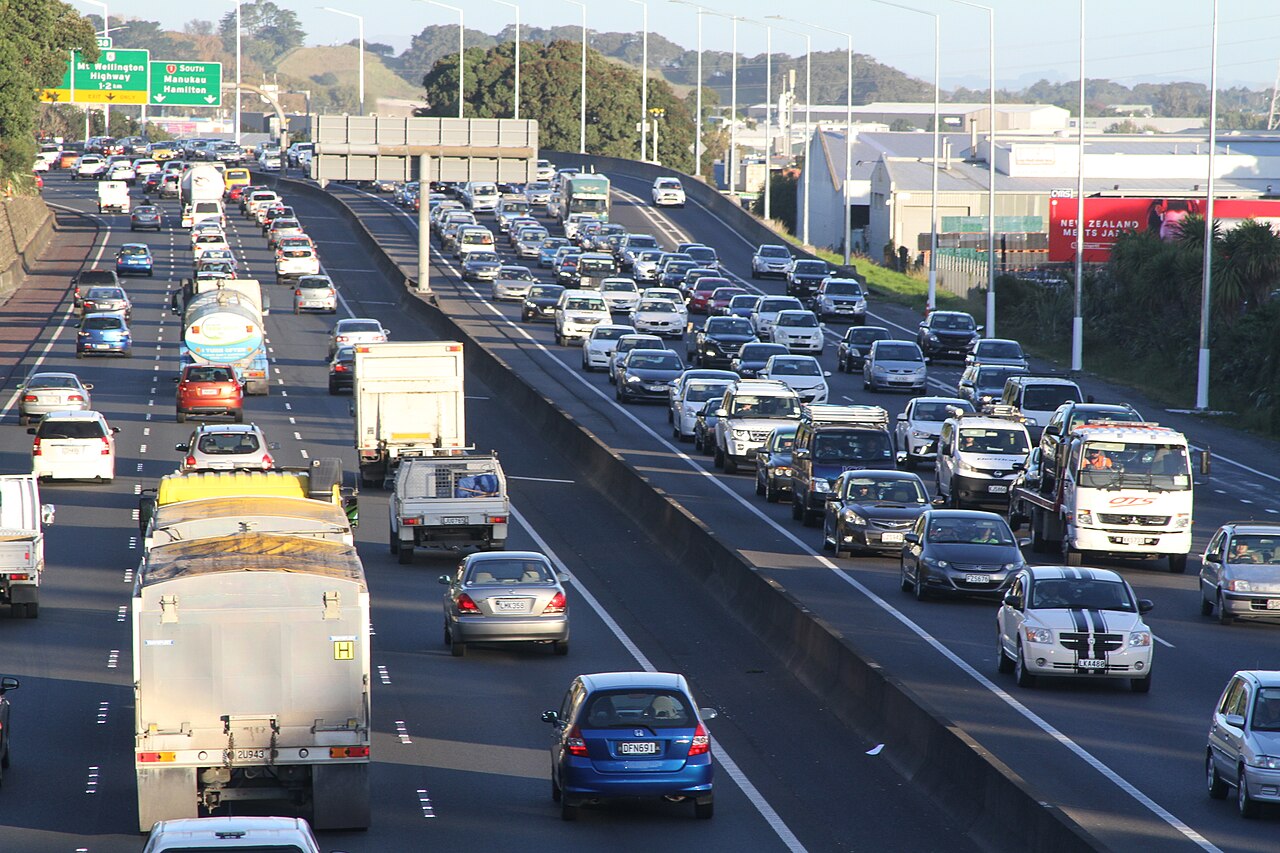
Fuel excise and road user charges feed the National Land Transport Fund, which pays for state highway maintenance like Auckland's Southern Motorway.
Every deferred cent reduces that hypothecated base. The Budget 2026 contingency of $450 million was described by Willis as a time-limited reserve for elevated fuel prices and supply risk, funded from the operating package so its use would not add to forecast debt. Applying it to structural NLTF revenue loss changes its character and shrinks headroom if oil prices spike again.
Hipkins has accused the government of treating that contingency as a general transport funding source rather than timely, targeted, temporary support.
Budget 2026 surplus track
Treasury's Fiscal Strategy Report 2026, released with Budget 2026 on 28 May, forecast OBEGALx returning to surplus at $2.6 billion in 2028/29 — a year earlier than HYEFU 2025 — then $6.1 billion in 2029/30. Near-term deficits remained large: $11.9 billion in 2025/26, $11.4 billion in 2026/27 and $4.3 billion in 2027/28 on the BEFU path.
OBEGALx path, 2025/26 to 2029/30
Treasury forecasts a return to surplus a year earlier than HYEFU 2025.
Source: Treasury Fiscal Strategy Report 2026 / Budget at a Glance 2026
The net operating package averaged $2.1 billion a year, under a $2.4 billion allowance. Budget also booked $150 million for strategic fuel reserves alongside the $450 million contingency.
Any permanent freeze financed by Crown top-ups or extra borrowing collides with that surplus and debt path unless offset by savings or other revenue. A delayed restart of 5-cent steps from 2028 rebuilds the user-pays base more slowly than the cancelled January 2027 cliff.
Household cashflow and market backdrop
A multi-year freeze or a smoother delayed path keeps pump prices lower than the prior 12-cent step for commuting households, trades, agriculture and freight. Global crude and the exchange rate still dominate the pump level. Brent crude last-day futures recently traded near US$96, with a 52-week high near US$126, according to Yahoo Finance chart data. A weaker NZ dollar raises the local cost of imported product.
Newsroom has tallied nearly $9 billion of Crown top-ups to transport funds since 2020. GPS 2024 had already flagged the revenue cliff when fixed-term Crown support rolls off and proposed restarting regular FED and RUC increases from 2027.
What PREFU and Labour's plan must answer
PREFU on 29 September should quantify the residual financing of the government's roughly $1 billion NLTF top-up after the contingency. Labour's subsequent fiscal plan must show whether its freeze is funded by further Crown grants, NLTF reprioritisation, borrowing, or a mix — and how that sits beside other tax and spending promises against the OBEGALx track.
Until those two documents land, voters and markets have National's published shortfall arithmetic and Labour's assertion that costings exist. The fiscal credibility test is whether the published baselines close the gap between pump relief and the user-pays fund that keeps roads and public transport solvent.