Methanex exit: two-speed NZ gas market explained — Economic News
GAS MARKET · METHANEX EXIT
Methanex exit eases wholesale gas, leaves households and industry exposed
Methanex’s Q1 2027 idle frees a large gas block for Genesis and other users, promising near-term wholesale relief. Household bills stay pinned by fixed network costs, while the loss of 95 TJ/day flex and a 731 PJ 2P base raise structural price and security risk.
"If major manufacturers and exporters have to step back because fuel isn't available, New Zealand is poorer for it. Keeping the lights on is vital, but energy security has to mean more than avoiding blackouts."John Carnegie, Energy Resources Aotearoa
Resources Minister Shane Jones will scrap petroleum royalties on non-saleable cushion gas, targeting a 2013 rule that charges developers 5% on original gas in underground storage facilities.
Farm-gate fertiliser has surged while retail food inflation sits at 1.9%. RBNZ’s September MPS still expects petroleum-linked costs to spill into food, transport and construction through late 2026.
The Coalition has put $3 million of Regional Infrastructure Fund operating money behind the Taranaki Alliance, an industry bid vehicle intended to redeploy oil-and-gas engineering skills as Methanex prepares to idle Motunui from early 2027.
Methanex Corporation will indefinitely idle its New Zealand methanol plants in the first quarter of 2027 and sell substantially all of its domestic natural gas contractual entitlements through the end of the decade. The move, disclosed in a Form 6-K filed with the US Securities and Exchange Commission on 1 September 2026, releases New Zealand’s largest industrial gas user from a tight market.
Clarus general manager Ben Gerritsen told RNZ’s Nine to Noon that near-term industrial and some household wholesale pressure should ease. He warned that fixed pipeline costs mean North Island residential tariffs will not fall one-for-one with any commodity relief. Genesis Energy has secured the bulk of the freed volumes. The trade-off is clear: electricity firming gains time; industrial underwriting and dry-year flex shrink.
Why the price path splits in two
Methanex has been the system’s single largest gas consumer. Industry and media estimates put its share near 40 percent of national gas, and at times close to half. Roughly 95 percent of its methanol left for Asia-Pacific markets. In recent winters the company also acted as the primary demand-response valve. It matched rates down, idled trains, and on-sold contracted gas to gentailers when hydro storage ran low.
Gas Industry Co’s 2026 Supply and Demand Study quantified that contractual flexibility at up to 95 terajoules a day. In 2024 Methanex effectively released about 22 petajoules between March and October. That volume was comparable to gas-fired generation’s roughly 20 PJ over the same window. Ahuroa storage contributed only about 3.1 PJ. When Methanex exits as a consumer from Q1 2027, those entitlements flow largely to Genesis.
Genesis Energy said it secured 11.4 PJ of third-party gas from March 2027 to December 2029. It also exercised a Kupe right of first refusal for up to 8.6 PJ. Multiple outlets, including BusinessDesk and Energy Resources Aotearoa, identify Genesis as the counterparty. Methanex’s SEC release did not name the buyer. Genesis framed the package as enough gas to meet forecast retail demand and support a shift away from baseload gas generation.
Spot and short-term bilateral tightness should ease for remaining commercial and industrial buyers who have struggled to recontract. emsTradepoint still accounts for only about 6 percent of volumes. Roughly 95 percent of gas moves on bilateral long-term contracts. Daily delivered VWAP sat in the mid-teens dollars per gigajoule in early September 2026 after ending 2025 softer at $9.53/GJ under strong hydro.
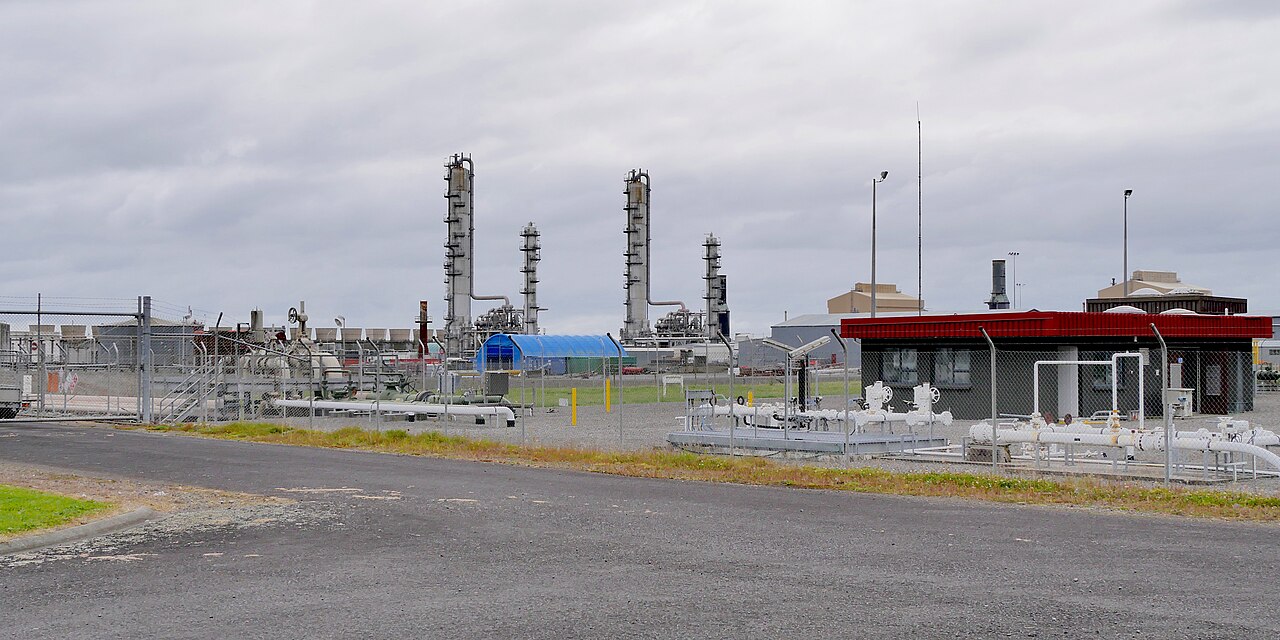
Methanex's Taranaki methanol plant, which will indefinitely idle in Q1 2027 as the company sells its gas entitlements to Genesis Energy.
The drivers behind the two-speed market
New Zealand’s gas balance has collapsed faster than most transition narratives assumed. MBIE’s petroleum reserves release for 1 January 2026 put 2P gas at 731 PJ. That was down 217 PJ, or 23 percent, from 948 PJ a year earlier—the lowest level in the roughly 20-year MBIE record. Of the drop, 108 PJ was 2025 extraction. Another 109 PJ came from downward revisions, led by Pohokura at minus 129 PJ. Turangi now holds about 380 PJ, or 51 percent of remaining 2P. Contingent 2C resources were 1,950 PJ, down 3 percent. Operators’ production profiles pointed to only about 85 PJ of national production in calendar 2026, 15 percent lower than the prior profile.
MBIE’s Energy in New Zealand 2025 recorded 2024 gas supply at 115.70 PJ, down 20.9 percent year on year. The multi-year 2P path is steep: roughly 1,300 PJ at 1 January 2024, 948 PJ at 1 January 2025, and 731 PJ at 1 January 2026.
Maui, historically the backbone field, is expected to cease production around end-2026. The Commerce Commission’s Gas DPP4 final reasons paper of 27 May 2026 states Maui produced about 17 PJ in 2024 and its exit removes about 40–50 TJ a day. Timing depends on late-life performance. The Commission linked a closely timed Methanex shutdown as widely expected. Non-Maui gas previously used by Methanex could re-enter the market depending on sequencing.
CEO Rich Sumner said the New Zealand facilities have operated more than four decades. For several years Methanex matched operating rates to scarce supply and sold gas into domestic energy markets when appropriate. The company judged continued operations unsustainable given the decline in domestic gas availability and no clear pathway to meaningful new supply. It does not expect material cash costs from the idle decision and will preserve the plant for possible restart.
Where the trade-off bites
Demand destruction eases spot and short bilateral tightness for remaining industrials. It also removes the system’s primary interruptible valve. Ahuroa, operated by Flexgas and Clarus, offers up to about 65 TJ a day of inject and withdraw capacity. Effective working gas is often modelled at roughly 6–8 PJ excluding cushion gas. That cannot replace 95 TJ a day of Methanex flex. Gas Industry Co notes dry-year electricity may need an extra 10–20 PJ of gas. Without Methanex flexibility, the indigenous-only path creates shortage risk for either gas consumers or generation.
Genesis can serve retail gas customers, run Huntly Unit 5 and the Rankine units when spark spreads work, wholesale to other industrials or gentailers, or park gas in storage if Tariki or Ahuroa capacity is contracted. Unit 5 is a roughly 400 MW combined-cycle plant. Each Rankine unit is about 240 MW. Genesis Investor Day 2025 materials explicitly framed a “Methanexit” scenario and the company’s ability to absorb gas on commercial terms. Concentrating entitlements in one gentailer improves the electricity dry-year hedge path. It does not restore the upstream investment case that a large industrial offtaker once underwrote.
The Government’s $200 million Gas Security Fund, administered via Kānoa, has made its first awards. Resources Minister Shane Jones and Associate Finance Minister Chris Bishop announced up to $23.5 million in time-limited loans to Todd Energy. The McKee Gas Cap project receives up to $16.2 million plus about $7 million from Todd. The McKee-Tariki production well receives up to $7.3 million plus about $3.1 million from Todd. Together the projects target up to 19.9 PJ of additional reserves over five to nine years, or about 4 PJ a year at peak—roughly 6 percent of expected 2027 production. First gas is targeted for end-2027 if successful. Jones has said he intends to allocate the full fund before the election. Energy Resources Aotearoa noted about 17 proposals in the pipeline. The scale remains small against a multi-hundred-PJ reserve hole and the roughly 27.7 PJ of petrochemical demand Gas Industry Co removes in 2027 under an indigenous-only scenario.
Commerce Commission DPP4, from 1 October 2026, shortens regulatory asset lives and grapples with economic network stranding as throughput declines. Fixed network costs will be spread over a shrinking commodity base. That is the same dynamic Gerritsen cites for household bills. Any wholesale commodity easing is second-order for residential tariffs.
LNG import procurement, if delivered, would cap dry-year spikes and set a security floor. It would also relink domestic industrial and thermal costs to Asian cargoes plus regasification and transport. That ends the stranded-gas era that once made Motunui competitive on local feedstock. Who pays for terminal capacity remains an open fiscal and commercial question.
Second-order effects for households and business
Ballance Agri-Nutrients’ Kapuni urea plant already shows the industrial stress. In its FY25 results Ballance recorded an about $88 million one-off write-down on the plant. Underlying earnings before tax of $38 million became a $49 million net loss before tax after the charge. The long-term Greymouth contract expired on 30 September 2025. Affordable recontracting failed. The Kapuni cash-generating unit’s recoverable amount was assessed as nil, with an $82.8 million PPE impairment plus related inventory write-down. The plant has operated since 1982, employs about 120 people, manufactures roughly 260,000 tonnes of urea a year—about one-third of New Zealand supply—and consumes about 7 PJ of gas a year. Short rolling contracts and urea import contingency now form a live viability test. Intermittent operation or exit would transmit into farm-gate nutrient costs.
Port Taranaki methanol trade has already collapsed. Volumes fell from 1.71 million tonnes to 1.28 million tonnes in FY2023–24, then to 518,000 tonnes in FY2024–25. Total port trade was 3.10 million tonnes, down 20.7 percent year on year. Full Motunui idle will cut stevedoring and regional contractor activity further. The port has already pivoted toward bulk-dry growth as liquids shrink.
Energy Resources Aotearoa chief executive John Carnegie put peak Methanex export contribution at about 0.4 percent of GDP, or around $1 billion. More recently the figure sat between 0.15 and 0.25 percent. Permanent exit is demand destruction, not temporary curtailment. Terms-of-trade loss is real even if the electricity system gains firming gas.
On the electricity side, more gas at Huntly can damp dry-year wholesale spikes relative to the path seen when August 2024 spot electricity reached $488/MWh without full Methanex diversion. Coal, biomass, heavy fuel oil and eventual LNG remain in the stack. Gentailer earnings sensitivity to gas and coal spreads will stay a recurring narrative for NZX-listed energy names, including Genesis on the NZX Main Board.
Carbon leakage is the other side of the industrial coin. Methanol tonnes shift to Methanex jurisdictions that still run—US Gulf, Chile, Trinidad and others. Domestic closure does not cut global emissions one-for-one. Exploration without an anchor offtaker raises the required return even with Gas Security Fund co-investment. Energy Minister Simeon Brown has framed eight gas fields as expected to close between now and 2036.
Household energy affordability still runs mainly through electricity bills and regulated gas network charges, not wholesale commodity relief. North Island cooking and heating gas users will see DPP4 and distributor pricing methodologies dominate the energy component of their bills.
New Zealand 2P gas reserves, 2024–2026
Reserves have fallen for three straight years as extraction outpaces new discovery and revisions cut prior estimates.
Source: MBIE petroleum reserves releases
Historical context: de-industrialisation, not a sudden shock
This is the largest single demand-destruction event in modern New Zealand gas history. It completes a multi-year arc rather than delivering a surprise. Waitara Valley was idled indefinitely in the first quarter of 2021 for lack of economic gas. September 2024 restructuring cut Motunui to one train and cost about 70 jobs then. 2025 production fell to 507,000 tonnes from 670,000 tonnes on remaining 860,000-tonne operating capacity. Second-quarter 2026 New Zealand production was only 46,000 tonnes after a planned winter outage to free gas for electricity. The plant restarted in July at reduced rates.
Europe and the United Kingdom after 2022 offer the closest industrial analogue. Permanent high feedstock prices drove fertiliser, chemicals and methanol curtailments. Plants idled. Imports substituted. Regional employment and export earnings left. Chile and Trinidad methanol peers in Methanex’s own portfolio illustrate the global arbitrage: capital and operating rates follow gas abundance.
Australia’s east coast, summarised in the ACCC Gas Inquiry June 2026 interim report, shows a different institutional stack. Long-term producer-to-retailer offers for 2026 supply averaged A$13.61/GJ. Retailer commercial and industrial offers averaged A$13.89/GJ. First-quarter 2026 agreed 2027 producer-retailer GSAs averaged A$12.92/GJ. East-coast tightness is managed with storage and, critically, an LNG export industry that creates netback linkage to Asian prices, plus political instruments that can prioritise domestic supply. New Zealand has neither export netback nor an operating import terminal yet. Domestic prices have been set by scarcity and bilateral bargaining among a handful of producers and large users.
The counter-argument: electricity security first
The strongest opposing read is that “Methanexit buys time” for electricity security and Rankine and Unit 5 firming. Genesis’s book is stronger. Huntly can absorb gas on commercial terms. Dry-year hedge costs may fall relative to a no-Methanex-flex counterfactual. Energy Resources Aotearoa itself acknowledged that Genesis’s new arrangements strengthen electricity security even while it criticised the industrial cost.
That read is true for the electricity system and incomplete for the wider industrial economy. Carnegie stated the point directly:
keeping the lights on is vital, but energy security has to mean more than avoiding blackouts. It also means having enough affordable energy for businesses to keep producing.
Gerritsen’s transmission point lands the household side: fixed network costs limit pass-through of any wholesale easing. The thesis that this is a two-speed market—near-term wholesale and electricity relief versus structural industrial and long-term price risk—rests on the reserve path, Maui timing, the 95 TJ/day flex hole, and the small scale of first Gas Security Fund projects relative to the hole they are meant to fill.
A second counter-read blames the 2018 offshore exploration ban as the decisive cause. Energy Resources Aotearoa advances that line. Others emphasise geology and late-life field performance regardless of the 2018 policy. The reserve data show both extraction and large downward revisions. Policy and geology are not mutually exclusive explanations. Restart optionality at Motunui is real on paper. Restart still needs multi-year firm gas at methanol-competitive netbacks. The current 2P path does not show that abundance.
Open questions the next year will answer
Exact Genesis continuous-disclosure terms for the 11.4 PJ third-party volume, the 8.6 PJ Kupe ROFR, and any own-production carry still warrant primary NZX PDF verification; multi-outlet consistency is high but attribution remains “Genesis said, as reported.” Maui late-life timing and the sequencing of non-Maui volumes previously contracted to Methanex will determine how cleanly supply re-enters. Whether Genesis on-sells material volumes to other industrials or absorbs most gas at Huntly will shape emsTradepoint liquidity and C&I contract availability.
Ballance’s recontracting path and the share of urea imports through winter 2027 is the next industrial stress test. Todd’s McKee and Tariki delivery versus slippage, the remaining proposals under the Gas Security Fund, and the pace of full-fund allocation before the election will show whether Crown co-investment can move the production needle. LNG import procurement—developer, location, tariff allocation, first-cargo date—will decide whether international netback becomes the domestic floor.
Cabinet’s interim disclosure regime, requiring gas-fired generators and users above 1,000 TJ a year to lodge supply agreements with MBIE, should give ministers earlier warning of further industrial distress. Commerce Commission and retailer implementation of DPP4 will set the network-charge path that dominates household gas bills.
Watch the first post-Methanex winter in 2027, Maui’s final production month, Todd’s end-2027 first-gas target, and any LNG terminal final investment decision. Those four markers will show whether near-term relief compounds into durable security or simply marks another step in managed demand destruction on a shrinking indigenous base.