Regulatory Delays Sap Hawke's Bay Land Values and Stall Primary Sector Investment
Land values on Hawke's Bay's Heretaunga Plains have halved in some cases amid water insecurity and stalled consents. Regulatory uncertainty from the TANK plan and RMA transition now imposes clear economic costs on one of New Zealand's key growing regions.
Cabinet has approved the transfer of any remaining assets and obligations from New Zealand Green Investment Finance to Crown Regional Holdings Limited, New Zealand Growth Capital Partners, Aspire NZ Seed Fund and Treasury.
New Zealand risks forgoing $11 billion to $12 billion in Emissions Trading Scheme auction revenue by 2035 without major reforms, according to a Motu Economic and Public Policy Research report released this month.
Inland Revenue will conduct additional stakeholder consultation on proposals to modernise the Goods and Services Tax Act, a 20 November 2026 NBR report confirmed, citing resource constraints that rule out a full rewrite.
Land values on Hawke's Bay's Heretaunga Plains have halved in some cases. Water insecurity combines with regulatory delays to block new consents and deter capital. This pattern shows how prolonged uncertainty in allocation rules damages productive land use.
The Heretaunga Plains generate 80 percent of Hawke's Bay regional GDP. The aquifer that supports horticulture, viticulture and arable farming sits at or beyond sustainable limits. Banks now hesitate on lending without secure water rights. Investors shift capital elsewhere.
Hawke's Bay regional GDP reached $12.6 billion in the year to March 2025. Agriculture, forestry and fishing accounts for 13 percent of regional employment. National food and fibre exports are forecast at a record $62 billion for the year to June 2026. Disruptions here carry national weight.
The Drivers of Uncertainty
Scientists identified the aquifer at its limit nearly ten years ago. Hydrogeological studies from the 1990s already showed interconnection between surface water and groundwater. Recharge comes mainly from the Ngaruroro River. Abstraction, especially for irrigation, has driven gradual declines of 0.4 to 2 metres over four decades according to Hawke's Bay Regional Council technical reports.
The TANK Plan Change covers the Tūtaekurī, Ahuriri, Ngaruroro and Karamū catchments. It proposes cutting consented groundwater allocation from around 160 million cubic metres per year to 90 million cubic metres. Calculation shifts to actual and reasonable use from 2010 to 2020 rather than paper entitlements. In some years actual use fell as low as 30 to 40 million cubic metres according to Farmers Weekly reporting.
The plan notified in 2020 took legal effect on 2 May 2020. A consent order version issued 29 April 2026. Yet Environment Court appeals and the broader RMA overhaul keep the process stalled. No new consents can be applied for. Around 1,000 consent holders face prolonged limbo.
The RMA reform bills passed Parliament in September 2026. The full new system is intended by 2030. Transition rules create a consent freeze that locks in existing patterns. This extends the period of uncertainty beyond the original TANK timeline.
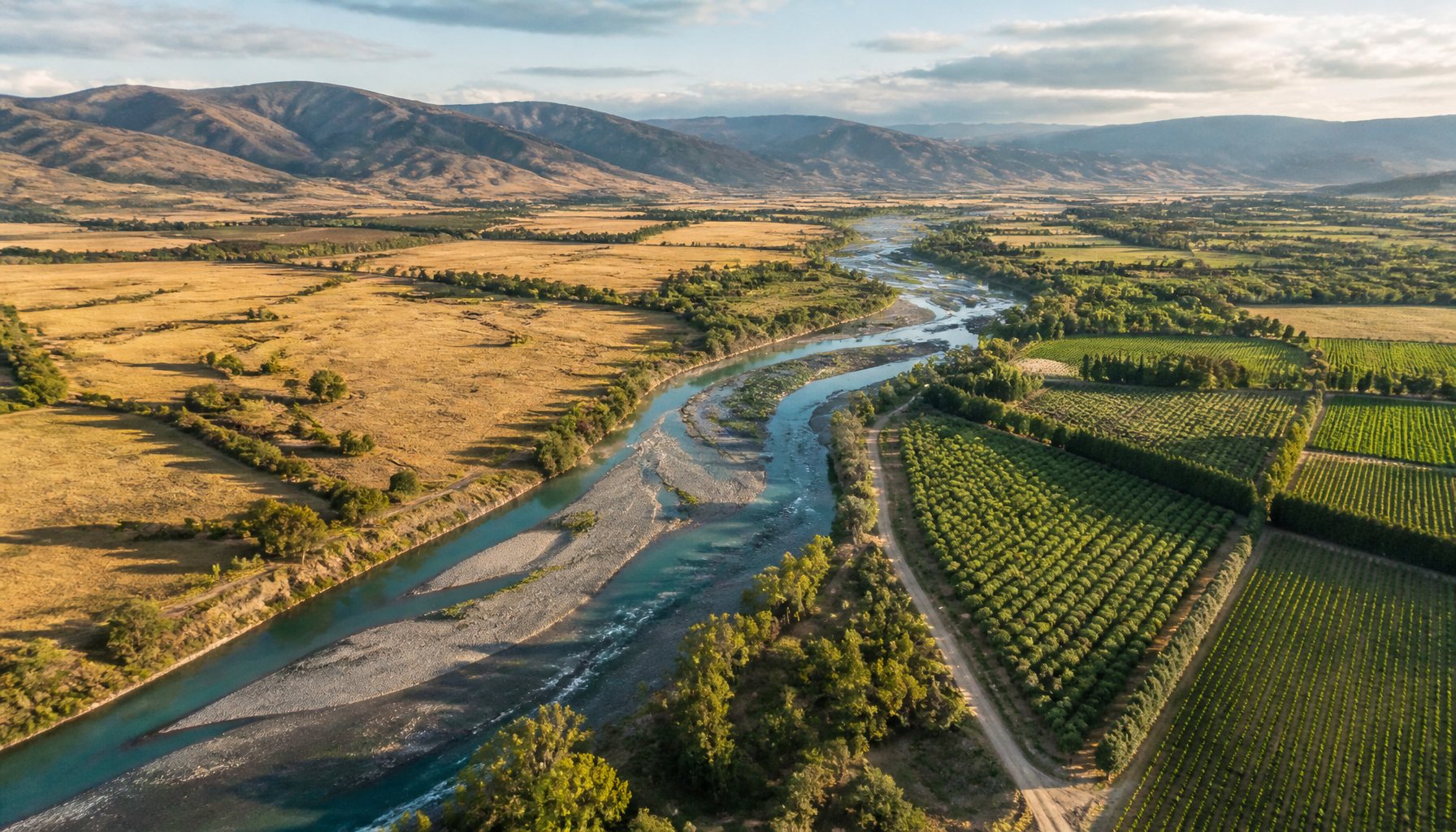
AI illustration of a river plain with irrigated orchard blocks beside drier paddocks, evoking the uneven water security across Hawke's Bay's Heretaunga Plains.
Groundwater abstraction for irrigation has risen steadily since 1980. Modelling shows irrigation pumping responsible for much of the summer declines and reduced river flows, up to 50 percent loss in the Ngaruroro under dry conditions per HBRC executive summaries.
The Trade-offs
Stricter allocation aims to restore environmental flows and protect spring-fed streams. A sinking lid on consents seeks sustainability over decades. These goals carry weight given observed level declines.
Yet the economic trade-off appears immediate. Land with secure water historically traded around $150,000 per hectare. Land without secure allocation trades as low as $75,000 per hectare according to Farmers Weekly analysis. Some sales have halved in recent years. Growers' modelling puts worst-case local economic costs of allocation cuts at $4 billion.
Land with secure water historically traded around $150,000 per hectare. Land without secure allocation trades as low as $75,000 per hectare.
Banks treat water rights as core security for lending. Without confirmed allocations, debt finance for orchards or vineyards tightens. Capital-intensive activities slow. Lower-water uses such as pasture for sheep, beef and dairy gain relative appeal, especially after strong 2025-2026 red meat demand.
The TANK framework recognises actual use rather than inflated entitlements. This corrects over-allocation on paper. At the same time it reduces flexibility for existing operations that expanded within historical limits.
Second-order Effects
Investment diversion already occurs. Fruit exporter Greig Taylor of FreshCo has shifted some activity to Nelson where water security appears stronger. Similar decisions compound across the region.
Land-use shifts accelerate. Hundreds of hectares of vineyards face removal nationally, with Hawke's Bay contributing, driven partly by global oversupply but amplified by water doubts. The McCain Hastings plant closure already impacted 100 local growers. Further consolidation toward livestock reduces high-value horticultural output.
Employment effects follow. Processing, contracting and transport jobs tied to intensive cropping face pressure. Regional population projections to 210,000 by 2053 could slow if productive capacity contracts.
Export earnings within the national food and fibre sector face indirect constraint. Hawke's Bay contributes materially to horticulture and viticulture volumes. Sustained uncertainty risks eroding that share versus irrigated competitors in Australia or other New Zealand regions.
Fiscal impacts reach local councils through rating valuations tied to productive land. Lower land values reduce the rating base over time.
Historical Context
Early management assumed abundant or unlimited supply. Science updates from the 1990s onward documented stream depletion effects and seasonal drawdowns. The 2017 science update to the TANK group reinforced the need for tighter limits.
In 1994-95, 66 million cubic metres of groundwater was abstracted from the Heretaunga Plains aquifer per Hydrogeology Journal data. Abstraction rose thereafter with irrigation expansion. The shift from assumed plenty to measured limits spans four decades of gradual recognition.
Parallel efforts include natural recharge trials and efficiency measures. These build on long-standing hydrogeological understanding yet require coordinated implementation.
The Counter-Argument
Proponents of strict allocation argue that environmental limits must bind first. Unchecked abstraction risks permanent aquifer damage and reduced river flows that affect ecology and downstream users. International examples such as Australia's Murray-Darling Basin show protracted battles until trading and storage mechanisms deliver certainty.
The RMA reform and TANK appeals process aim to embed robust science and stakeholder input. Rushed consents could lock in unsustainable patterns for decades. A pause allows the new legislative framework to apply consistently from 2030.
Evidence for this view rests on observed level declines and modelling of irrigation impacts. HBRC technical reports document the data. Yet the same reports note that actual use often sits well below paper entitlements, suggesting room for managed adjustment rather than abrupt cuts.
Open Questions
The Heretaunga Water Storage Project now sits with Heretaunga Water Storage Limited. The proposed 27 million cubic metre reservoir at Whanawhana would capture winter flows for summer release. Feasibility work continues into 2026-2027 with involvement from mana whenua, irrigators, industry and councils. Kānoa funding support assists.
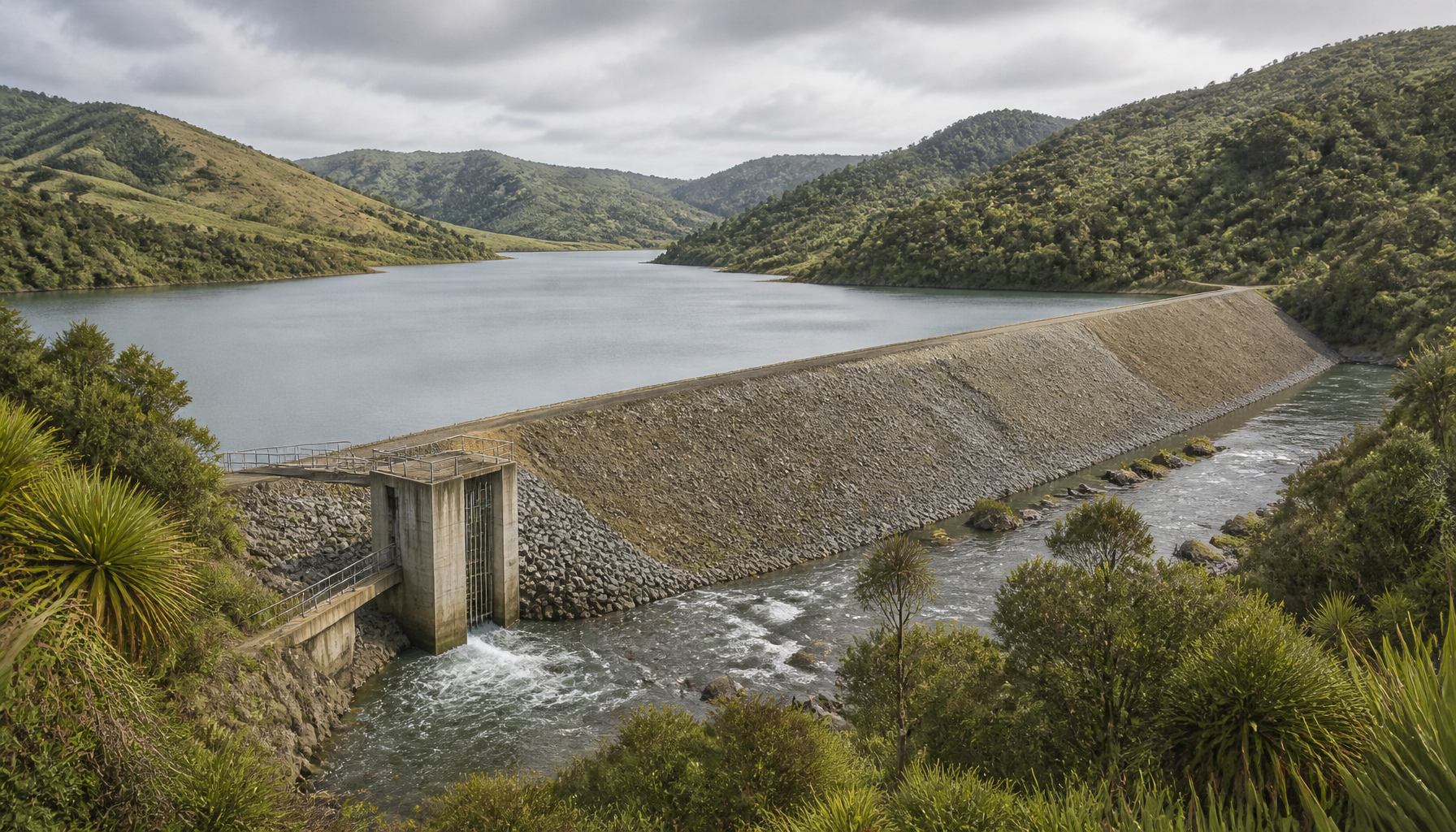
AI illustration of a river storage reservoir concept, similar in principle to the proposed 27 million cubic metre Whanawhana project intended to capture winter flows for summer release.
Key tests remain.
Will the reservoir deliver new or secure allocations without further regulatory delay?
How will the post-2030 RMA system handle existing appeals and consent renewals?
What volume of efficiency gains and recharge can offset allocation pressure?
Growers note that 100 of about 1,000 consent holders have accepted new allocations offered under TANK. Broader uptake depends on final rules and storage outcomes.
The next milestones include completion of storage feasibility studies and initial implementation steps under the new resource management legislation. Resolution here will determine whether Hawke's Bay retains its position as a premier growing region or continues to absorb the costs of extended uncertainty.