Ministry Maps 260 Regulators Revealing Overlap, Releases AI Efficiency Guidance
New Zealand has more than 260 regulators, a new government report shows, exposing decades of overlap and complexity across central government, local councils and statutory bodies.
Auckland’s potential $5 billion Fast-track infrastructure exposure and 16,270 wrongly suspended Winter Energy Payments have become the first real-world stress tests of the Regulatory Standards Act 2025.
Cabinet’s Economic Policy Committee has formally authorised public consultation on a prudential levy to shift Reserve Bank supervision costs onto banks, insurers and market infrastructure operators from 2027/28.
Cabinet has agreed in principle to three shifts in public performance reporting sought by the Finance and Expenditure Committee, while parking detailed design and costings until 2027.
New Zealand has more than 260 regulators, a new government report shows, exposing decades of overlap and complexity across central government, local councils and statutory bodies.
Regulatory Landscape Mapped for First Time
The Ministry for Regulation released its report The state of New Zealand's regulatory systems on or around 20 May 2026. The document provides the first consolidated picture of regulatory organisations.
It identifies 95 regulators in central government, 79 in local government and 57 statutory bodies, committees or tribunals. Multiple agencies often oversee the same issues under hundreds of Acts.
Regulation Minister David Seymour said the mapping exposes decades of overlap and complexity, and that the Ministry will use it to identify overlap, duplication and unnecessary complexity.
Seymour stated that outside Wellington, households and businesses have found ways to do more with less, and that it is reasonable to ask the same of the agencies they fund.
"Outside of Wellington, improvements in productivity and efficiency are the norm. Households and businesses have found ways to do more with less. It's reasonable to ask the same of the agencies they fund." — David Seymour, Regulation Minister
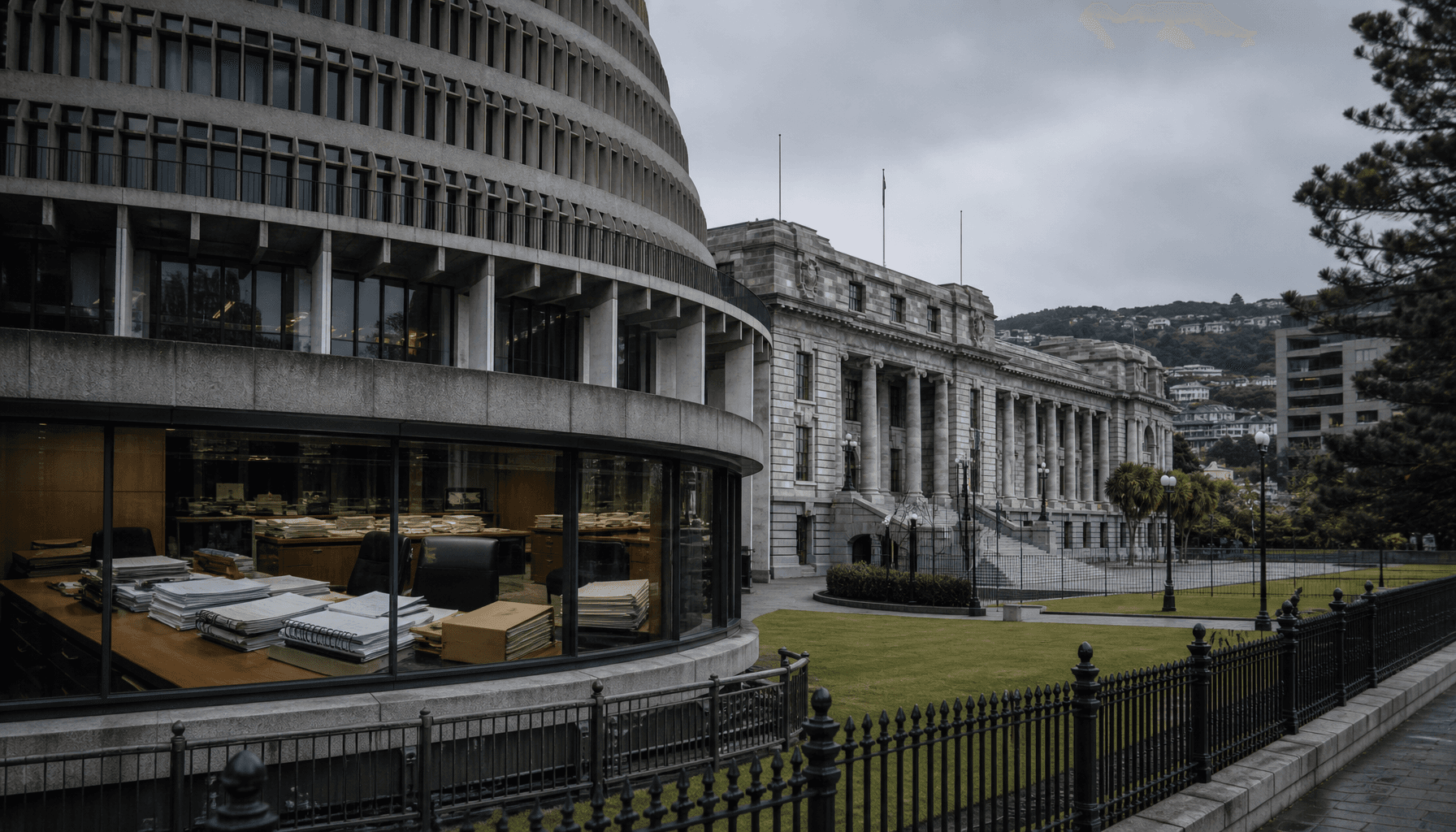
Lambton Quay, Wellington — home to many of the 95 central-government regulators identified in the Ministry for Regulation's landmark mapping report released 20 May 2026. Photo: Phillip Capper · CC BY 2.0 · Wikimedia Commons
AI Guidance Targets Lower-Risk Uses
Alongside the mapping, the government issued AI guidance for regulators. The resources sit on the Ministry for Regulation website as part of the Responsible AI in action suite.
The guidance focuses on lower-risk applications where AI can analyse data at scale, draft documents rapidly and identify patterns.
He added that regulatory decisions still rely on human judgement, legal interpretation and accountability.
NZ Labour Productivity Growth by Sector, Year Ended March 2025
Primary industries outpaced services in the most recent year; decade average remains subdued.
The Ministry for Regulation was established in 2024. According to BusinessDesk, it has grown to more than four times the size of the Productivity Commission it replaced, with contractor spending exceeding $2.75 million in its first two years.
Stats NZ data for the year ended March 2025 show labour productivity rose 1.1 per cent in measured-sector services and 4.0 per cent in primary industries. Average annual growth over the decade to 2025 stood at 0.6 per cent.
The report offers no immediate consolidation blueprint or quantified savings targets.
Opposition and stakeholder comment was not available before deadline.
Broader Reform Aims
The initiative builds on the National AI Strategy launched in July 2025 and the Public Service AI Framework released in January 2025. It positions AI as a tool to reduce bureaucracy without expanding headcount.
"In a high-cost economy, regulation isn't neutral — it's a tax on growth. This Government is committed to clearing the path of needless regulations by improving how laws are made and applied." — David Seymour, Regulation Minister
Potential effects include faster processing for businesses and lower compliance costs, though outcomes depend on adoption across the 260-plus regulators.
The mapping aligns with ongoing efforts to improve law-making scrutiny and regulator capability. The Ministry has committed to maintaining and updating the regulatory map, using AI-assisted analysis to identify overlap and duplication, and running cost-benefit reviews on regulations that have not been examined in years.